
316 (A4) · A4-80 · Class 5 · Class 8 · Mild Steel
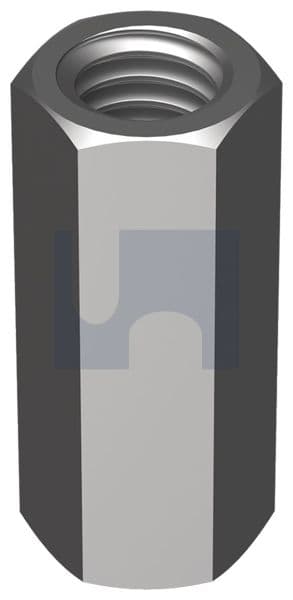
Hex Coupler Nut
Hex coupling (extension) nut with a long body used to join two lengths of threaded rod or connect studs.
About the Hex Coupler Nut
Coupling nuts, also called hex couplers or long nuts, join two lengths of threaded rod or studs, most often to extend rod for hanging cable tray, ducting and pipes. They come in steel from M6 to M48 (zinc plated, Hobkote, zinc yellow or hot dip galvanised, class 5 and 8), in 316 stainless from M6 to M36 plus a Neptune A4-80 M12, and in zinc plated mild steel BSW from 1/4 to 7/8 inch. Choose the size, finish and class above; the guide below covers how much thread each rod needs and proof loads.
Also called coupling nuts, long nuts or threaded rod couplers.
Features
- Long body joins two threads
- Connects threaded rod and studs
- Class 5 and class 8 steel
- 316 stainless option
- Hot dip galvanised, zinc, HOBKOTE, zinc yellow
- Metric and imperial
Applications
- Extending threaded rod
- Hanging and bracing runs
- Construction, plumbing and electrical
- Suspension and support systems
What a coupling nut does
A coupling nut is a long hex nut with one continuous internal thread. Hobson describes its hex couplers as a connection of two male threads, most commonly threaded rod: screw a rod into each end and the two become one longer length. They are also called long nuts, extension nuts and threaded rod couplers.
Common uses are extending threaded rod for hanging cable tray, HVAC ducting, pipes and other services, and joining studs or rod in fabrication. Hobson publishes proof loads for some ranges (see the table) but no working load for any coupler, so a hanging, suspension or bracing system that carries a load needs the rod, coupler and anchor specified by its designer or an engineer.
How to join allthread with a coupler
Hobson's coupler data sheets set the rule: to reach the coupler's stated mechanical properties, each rod must be engaged by at least 1 x its diameter (D). The standard couplers are 3 x D long, which leaves room to adjust at either end.
- Match the coupler to the rod: same diameter and same thread (metric coarse for M sizes, BSW for the imperial couplers).
- Mark each rod at half the coupler length, for example 18mm on each rod for an M12 x 36mm coupler. That is more than the 12mm minimum and leaves the joint centred.
- Screw the coupler onto the first rod up to its mark.
- Screw the second rod into the other end up to its mark, holding the coupler with a spanner of the size in the table.
- Check both marks sit at the ends of the coupler, so each rod has at least 1 x D of thread inside it.
Coupling nut sizes, spanner sizes and proof loads
Every coupler we carry, grouped by finish and class, smallest to largest. The spanner size and proof load come from Hobson's data sheets for the zinc plated and galvanised class 5, galvanised class 8 and 316 stainless couplers; Hobson publishes no sheet for the Hobkote, zinc yellow, Neptune and BSW couplers, so those cells are blank.
Length in mm. Spanner size is across flats (mm). Proof load in kN is a test value from Hobson's sheets, reached only with at least 1 x D of thread engaged on each rod; it is not a working load. Hobson tested the 316 couplers at an ambient 10 to 35°C and says their properties can vary outside that range. Pack is the minimum order quantity. Tap a number to show it in the selector above.
| Size | Finish and class | Length (mm) | Spanner (mm) | Proof load (kN) | Pack |
|---|---|---|---|---|---|
| Zinc plated, class 5 (metric) | |||||
| M6 | Zinc plated, class 5 (metric) | 18 | 10 | 11.7 | 100 |
| M8 | Zinc plated, class 5 (metric) | 24 | 13 | 21.6 | 100 |
| M10 | Zinc plated, class 5 (metric) | 30 | 16 | 34.2 | 100 |
| M12 | Zinc plated, class 5 (metric) | 36 | 18 | 51.4 | 100 |
| M16 | Zinc plated, class 5 (metric) | 50 | 24 | 95.8 | 50 |
| M20 | Zinc plated, class 5 (metric) | 60 | 30 | 154.4 | 25 |
| M24 | Zinc plated, class 5 (metric) | 72 | 36 | 222.4 | 20 |
| M30 | Zinc plated, class 5 (metric) | 90 | 46 | 353.4 | 5 |
| M36 | Zinc plated, class 5 (metric) | 108 | 55 | 514.7 | 5 |
| Hobkote, class 5 | |||||
| M10 | Hobkote, class 5 | 30 | 100 | ||
| M16 | Hobkote, class 5 | 50 | 50 | ||
| M20 | Hobkote, class 5 | 25 | |||
| Zinc yellow, class 5 | |||||
| M36 | Zinc yellow, class 5 | 70 | 5 | ||
| Hot dip galvanised, class 5 | |||||
| M10 | Hot dip galvanised, class 5 | 30 | 16 | 34.2 | 100 |
| M12 | Hot dip galvanised, class 5 | 36 | 18 | 51.4 | 100 |
| M16 | Hot dip galvanised, class 5 | 50 | 24 | 95.8 | 50 |
| M20 | Hot dip galvanised, class 5 | 60 | 30 | 154.4 | 25 |
| M24 | Hot dip galvanised, class 5 | 72 | 36 | 222.4 | 20 |
| M30 | Hot dip galvanised, class 5 | 90 | 46 | 353.4 | 5 |
| M36 | Hot dip galvanised, class 5 | 108 | 55 | 514.7 | 5 |
| Hot dip galvanised, class 8 | |||||
| M16 | Hot dip galvanised, class 8 | 50 | 24 | 138.2 | 50 |
| M20 | Hot dip galvanised, class 8 | 60 | 30 | 225.4 | 25 |
| M24 | Hot dip galvanised, class 8 | 72 | 36 | 324.8 | 20 |
| M30 | Hot dip galvanised, class 8 | 90 | 46 | 516.1 | 5 |
| M36 | Hot dip galvanised, class 8 | 108 | 55 | 751.6 | 5 |
| M42 | Hot dip galvanised, class 8 | 126 | 65 | 1,031.3 | 5 |
| M48 | Hot dip galvanised, class 8 | 144 | 75 | 1,355.2 | 5 |
| 316 stainless | |||||
| M6 | 316 stainless | 18 | 10 | 10.1 | singly |
| M8 | 316 stainless | 24 | 13 | 18.3 | singly |
| M10 | 316 stainless | 30 | 17 | 29.0 | singly |
| M12 | 316 stainless | 36 | 19 | 42.1 | singly |
| M16 | 316 stainless | 50 | 24 | 78.3 | singly |
| M20 | 316 stainless | 60 | 30 | 122.4 | singly |
| M24 | 316 stainless | 72 | 36 | 176.3 | singly |
| M30 | 316 stainless | 90 | 46 | 280.3 | singly |
| M36 | 316 stainless | 108 | 55 | 408.4 | singly |
| Neptune 316 stainless, A4-80 | |||||
| M12 | Neptune 316 stainless, A4-80 | 50 | singly | ||
| Zinc plated, BSW (imperial) | |||||
| 1/4 BSW | Zinc plated, BSW (imperial) | 20 | 100 | ||
| 5/16 BSW | Zinc plated, BSW (imperial) | 25 | 100 | ||
| 3/8 BSW | Zinc plated, BSW (imperial) | 30 | 100 | ||
| 1/2 BSW | Zinc plated, BSW (imperial) | 40 | 100 | ||
| 5/8 BSW | Zinc plated, BSW (imperial) | 50 | 50 | ||
| 3/4 BSW | Zinc plated, BSW (imperial) | 50 | 25 | ||
| 7/8 BSW | Zinc plated, BSW (imperial) | 50 | 20 | ||
Class 5, class 8 and 316: what the proof loads mean
- Class 5 couplers are made to the class 5 nut requirements of ISO 898-2 / AS/NZS 4291.2, and class 8 couplers to the class 8 requirements. Their proof loads match the class 5 and class 8 hex nut values on Hobson's hex nut properties sheet.
- The 316 stainless couplers are made to ISO 3506 property class 50 (A4-50), with a stress under proof load of 500 MPa. That is lower than class 5 steel, so a 316 coupler has a lower proof load than a steel one of the same size: 42.1kN against 51.4kN at M12. On A4-70 or A4-80 stainless rod, the coupler is the lower strength part. Hobson's 316 figures are from testing at an ambient 10 to 35°C; properties can vary outside that range.
- The Neptune M12 x 50mm coupler is listed as A4-80. Hobson publishes no data sheet for it.
- The M36 x 70mm zinc yellow coupler is shorter than the 3 x D pattern: at 70mm it cannot give 36mm (1 x D) of engagement on both rods, and Hobson publishes no sheet for it. To join M36 rod, use the 108mm M36 couplers.
- Proof loads are test values for the coupler alone. What a joint can carry depends on the rod, the anchors and how it is installed.
Which coupler finish: indoors, outdoors or near the sea
Hobson's corrosion guide for metal connectors sets the finish by exposure: zinc plated only for enclosed work in very low and low corrosion areas, and anything exposed to the weather in hot dip galvanised or 304 or 316 stainless, with stainless in the sea spray zone and 316 within 2m of a pool edge. Use the same finish as the rod and nuts on that job.
- Zinc plated: a 5 micron zinc coating, for indoor and non-corrosive conditions.
- Zinc yellow: also 5 micron, with a yellow passivate that resists corrosion better than clear zinc; for low corrosion areas or temporary fixing.
- Hobkote (M10, M16 and M20): a 5 to 8 micron zinc coating with a specially formulated passivation that Hobson says gives 33% more corrosion resistance than zinc plated.
- Hot dip galvanised: a 50 micron coating for long term outdoor work. Hobson has found no zinc whiskers on its hot dip galvanised products, which suits sensitive sites such as data centres, where whiskers from electroplated zinc can cause electrical faults.
- 316 stainless: for coastal, pool and wet areas. Stainless threads can gall (cold weld) when tightened; Hobson suggests a slower installation speed and a moly based thread lubricant. The ASSDA article Hobson publishes says mixing grades (a 316 nut on a 304 bolt) is not a reliable fix: galling is worse with fine threads, tight clearances, poor thread profiles, no lubrication, dirt and over-tightening, so keep threads clean and lubricated and do not overtighten.
Coupling nuts in Adelaide
Allmat supplies coupling nuts, threaded rod, nuts and washers to electricians, plumbers, HVAC installers and builders across Adelaide and South Australia. Add the couplers to a quote with your rod and anchors, and we will price the lot.
Coupling nuts and allthread for the job
Coupling nuts, threaded rod, nuts and washers in zinc, galvanised and stainless are available to order from Allmat for electricians, plumbers, HVAC installers, builders and trade across Adelaide and South Australia. Order through Allmat, we pick and pack it, then click and collect from the Allmat yard or have it delivered to site.
Goes with
Questions
What is a coupling nut used for?
Joining two male threads end to end, most commonly two lengths of threaded rod, for example to extend rod hanging cable tray, ducting or pipes. It is a long hex nut with one continuous thread.
Is a long nut the same as a coupling nut?
Yes. Long nut, coupling nut, extension nut, hex coupler and threaded rod coupler all describe the same part.
How far should the rod go into a coupler?
At least 1 x the rod diameter on each side, which Hobson's coupler sheets require for the coupler's stated properties: 10mm for M10, 12mm for M12. The standard couplers are 3 x D long, so marking each rod at half the coupler length centres the joint.
What size spanner fits an M10 coupling nut?
16mm for the zinc plated and galvanised class 5 couplers, and 17mm for the 316 stainless ones. M12 is 18mm (class 5) or 19mm (316), and M16 is 24mm on every sheet.
Galvanised or stainless couplers outdoors?
Either. Hobson's corrosion guide puts anything exposed to the weather in hot dip galvanised or stainless, with stainless in the sea spray zone and 316 within 2m of a pool. Zinc plated couplers are for enclosed, low corrosion areas. Match the rod.
How much weight can a coupling nut hold?
Hobson publishes proof loads (test values) for its zinc, galvanised and 316 couplers, not working loads, and only with at least 1 x D of thread engaged on each rod. Any rod hanging or bracing system that carries a load needs specifying by its designer or an engineer.
Do you have imperial coupling nuts?
Yes: zinc plated mild steel BSW couplers from 1/4 to 7/8 inch.
Where can I buy coupling nuts in Adelaide?
Order through Allmat. Order ahead by phone on 1300 03 03 63 or send your list for a quote, then click and collect from 25 Kapara Road, Gillman, or have them delivered to site.
Hex Coupler Nut: sizes and finishes we supply
44 lines by finish. Pick one above for its product code and pack sizes.
| Finish | Sizes | Lengths | Lines |
|---|---|---|---|
| Galvanised | M10, M12, M16, M20, M24, M30, M36, M42, M48 | 30 to 144 (9 lengths) | 14 |
| 316 Stainless | M6, M8, M10, M12, M16, M20, M24, M30, M36 | 18 to 108 (9 lengths) | 10 |
| Zinc Plated | M6, M8, M10, M12, M16, M20, M24, M30, M36 | 18 to 108 (9 lengths) | 9 |
| Zinc Plated | 1/4, 5/16, 3/8, 1/2, 5/8, 3/4, 7/8 | 20, 25, 30, 40, 50mm | 7 |
| Hobkote | M10, M16, M20 | 30, 50, 60 | 3 |
| Zinc Yellow Passivate | M36 | 70 | 1 |
Data sheets and documents
The documents for the product you choose are listed with the selector above. Here is every Hex Coupler Nut document from Hobson Engineering.
All Hex Coupler Nut documents (16)
Data sheets and technical data (9)
Need them in bulk?
Add the sizes you need to your quote, or send us your list and we’ll price the lot and supply it with the rest of your order.
Browse all nuts