304 (A2) · 316 (A4) · A2-70 · A4-70 · A4-80 · Class 04 · Class 10 · Class 6 · Class 8 · Grade 2 · Grade 5 · Grade 8
Nyloc Nut
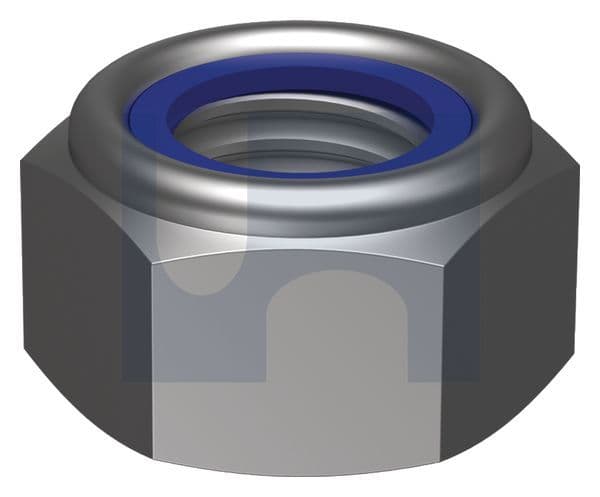
Nyloc hex nut, also known as a nylock nut, with a nylon insert ring that grips the bolt thread to resist loosening from vibration.
About the Nyloc Nut
Nyloc nuts are lock nuts with a nylon ring inside that grips the bolt thread so the nut does not shake loose, on trailers, farm machinery, vehicle accessories and anything else that vibrates. The standard nut runs from M2.5 to M64, zinc plated, zinc yellow or mechanically galvanised, or in 304 or 316 stainless, with fine pitch from M8 to M48 and imperial UNC, UNF and BSW from #4 to 2 inch. There are also thin, heavy, flange and dome nylocs, and brown ring high temperature (HUP) nylocs in zinc flake and 304 stainless. Choose the type, size and finish above; the guide below covers how they lock and tightening torques.
Also called nylon insert lock nuts, self locking nuts or nylock nuts.
Features
- Nylon insert for anti-vibration locking
- Prevailing-torque locking action
- DIN 985
- Steel classes 6, 8 and 10
- 304 and 316 stainless (A2/A4)
- Fine and extra-fine pitch options
- Metric and imperial
Applications
- Vibration-prone assemblies
- Mining and processing
- Railway and transportation
- Trailers, farm machinery and vehicle accessories
How nyloc nuts lock
A nyloc nut has a thin ring of nylon inside the top of the nut. The ring is not threaded: the bolt forms a thread in it as the nut goes on, and the grip of the nylon on the bolt adds friction that resists the nut working loose under vibration. That resistance is called prevailing torque.
Nyloc nuts are one kind of prevailing torque lock nut; cone lock and other all-metal lock nuts are another. Hobson's anti-vibration paper notes that nyloc nuts suit joints that do not need a large preload, and that a standard nylon ring is not for joints exposed to high temperatures. Hobson's HUP brown ring data sheet gives -40 to +120°C for a standard ring and -40 to +230°C for the brown ring.
Nyloc nut types
- Standard nyloc nut: the everyday full height nut, DIN 985 in metric, M2.5 to M64 and #4 to 2 inch.
- Neptune 316 stainless (DIN 985, A4-80): high tensile stainless nyloc nuts, M4 to M36.
- Thin nyloc nut: a lower nut for tight spaces. Metric thin nuts are ISO 10511 class 04 in M10 to M36, made for use with class 4.6 bolts; an M10 is 8.5mm high. Imperial thin nuts are zinc plated grade 2 or 304 stainless.
- Heavy nyloc nut: a taller nut. The DIN 982 heavy nuts (class 8 from M6 to M20, class 10 from M12 to M20) are 11.5mm high in M10, against 10mm for a standard nut, and there are DIN 6924 class 8 heavy nuts in M10 and M12.
- Hex flange nyloc nut (DIN 6926, no serrations): a built-in flange spreads the load like a washer. 304 stainless M4 to M16, zinc plated class 8 M6 to M12, and zinc yellow class 10 M12 to M24 for mining, agricultural equipment, general engineering, automotive and forklift work.
- Dome nyloc nut (DIN 986): 304 stainless with a closed dome over the bolt end, M5 to M12.
- HUP brown ring nyloc nut (ISO 7040): a temperature resistant nylon ring for -40 to +230°C, in zinc flake class 8 and 10 and 304 stainless A2-70, for mining and processing, rail and transport, energy, military and industrial work.
Classes, grades and finishes
The nylon itself copes outdoors: Hobson notes that long exposure to sun and salt may damage the ring, but in most conditions it still holds its prevailing torque, so nyloc nuts suit outdoor and marine work as long as the steel finish suits the site. A nut that has had long, harsh exposure should not be reused.
- Class 6, 8 and 10 (metric steel): Hobson's tightening torque sheets work the clamp load for class 6 nyloc nuts on a class 4.6 bolt, class 8 on an 8.8 bolt and class 10 on a 10.9 bolt.
- Grade 2, 5 and 8: the imperial steel nuts, all zinc plated except a mechanically galvanised grade 2 1/2 inch BSW.
- Zinc plated: a 5 micron zinc coating with a clear passivate, for indoor and non-corrosive conditions.
- Zinc yellow passivate: 5 micron zinc with a yellow passivate, more corrosion resistant than zinc plated, for low corrosion conditions or temporary fixing.
- Mechanically galvanised: a 50 micron coating with high corrosion resistance, similar to hot dip galvanising, with better abrasion resistance and no risk of hydrogen embrittlement.
- Zinc flake silver: a 10 micron coating with high corrosion resistance and no risk of hydrogen embrittlement (the brown ring nuts).
- 304 and 316 stainless: 316 has molybdenum added for better resistance near the sea. Neither 304 nor 316 is made to sit in seawater, and even 316 can visibly corrode where salt spray is left to build up.
Metric nyloc nut sizes
Every metric nyloc nut we carry. The size is the thread diameter (M10 fits a 10mm bolt) and the pitch is the distance between threads; coarse pitch is the everyday thread. Select a size to open it in the selector.
Every metric nyloc nut we carry, smallest to largest. zinc = zinc plated; mech gal = mechanically galvanised; numbers after a finish are property classes (04, 6, 8, 10); 304 and 316 are stainless. Brown ring HUP nuts (ISO 7040) are taller than standard DIN 985 nuts: an M10 HUP nut is 11.20 to 11.90mm high, against 10mm for a standard M10. Fine pitch nuts are standard height in zinc or zinc yellow, plus an M24 x 2.00 zinc yellow class 10 flange nut. Tap a number to show it in the selector above.
| Size | Coarse pitch (mm) | Standard height: finish and class | Brown ring HUP (ISO 7040) | Thin, heavy, flange and dome | Fine pitches (mm) |
|---|---|---|---|---|---|
| M2.5 | 0.45 | 304 | |||
| M3 | 0.50 | zinc 6/8, 304, 316 | |||
| M4 | 0.70 | zinc 6/8, 304, 316 | flange (304) | ||
| M5 | 0.80 | zinc 6/8, zinc yellow 8, 304, 316 | 304 | flange (304), dome (304) | |
| M6 | 1.00 | zinc 6/8, zinc yellow 8, mech gal 6/8, 304, 316 | 304 | heavy (zinc 8), flange (zinc 8, 304), dome (304) | |
| M8 | 1.25 | zinc 6/8/10, zinc yellow 8/10, mech gal 6/8, 304, 316 | zinc flake 10, 304 | heavy (zinc 8), flange (zinc 8, 304), dome (304) | 1.00 |
| M10 | 1.50 | zinc 6/8/10, zinc yellow 8/10, mech gal 6/8, 304, 316 | zinc flake 10, 304 | thin (zinc 04), heavy (zinc 8, zinc yellow 8), flange (zinc 8, 304), dome (304) | 1.00, 1.25 |
| M12 | 1.75 | zinc 6/8/10, zinc yellow 8, mech gal 6/8, 304, 316 | zinc flake 8/10, 304 | thin (zinc 04), heavy (zinc 8/10, zinc yellow 8), flange (zinc 8, zinc yellow 10, 304), dome (304) | 1.25, 1.50 |
| M14 | 2.00 | zinc 6/8/10, zinc yellow 8/10, mech gal 6/8, 304, 316 | flange (zinc yellow 10) | 1.50 | |
| M16 | 2.00 | zinc 6/8/10, zinc yellow 8, mech gal 6/8, 304, 316 | zinc flake 10, 304 | thin (zinc 04), heavy (zinc 8/10), flange (zinc yellow 10, 304) | 1.50 |
| M18 | 2.50 | zinc 8, zinc yellow 8, mech gal 6/8, 316 | 1.50 | ||
| M20 | 2.50 | zinc 6/8/10, zinc yellow 8, mech gal 6/8, 304, 316 | zinc flake 10 | thin (zinc 04), heavy (zinc 8/10), flange (zinc yellow 10) | 1.50 |
| M22 | 2.50 | zinc 6/8, 316 | 1.50 | ||
| M24 | 3.00 | zinc 6/8/10, zinc yellow 10, mech gal 6/8, 316 | thin (zinc 04), flange (zinc yellow 10) | 1.50, 2.00 | |
| M27 | 3.00 | zinc 6/8, mech gal 6, 316 | 1.50, 2.00 | ||
| M30 | 3.50 | zinc 6/8/10, zinc yellow 10, mech gal 6/8, 316 | thin (zinc 04) | 1.50, 2.00 | |
| M33 | 3.50 | zinc 6, zinc yellow 6, mech gal 6 | 3.00 | ||
| M36 | 4.00 | zinc 6/8/10, zinc yellow 10, mech gal 6/8, 316 | thin (zinc 04) | 3.00 | |
| M39 | 4.00 | zinc 6, zinc yellow 6 | 3.00 | ||
| M42 | 4.50 | zinc 6/8/10, mech gal 8, 316 | |||
| M45 | 4.50 | zinc 6, zinc yellow 6 | 3.00 | ||
| M48 | 5.00 | zinc 6/8/10, zinc yellow 10, mech gal 8, 316 | 3.00 | ||
| M56 | 5.50 | zinc 10, zinc yellow 10 | |||
| M64 | 6.00 | zinc 6/8/10, zinc yellow 10, mech gal 8 |
Imperial nyloc nut sizes: UNC, UNF and BSW
Imperial nuts are sized by the bolt diameter in inches (or gauge number for the smallest) and threads per inch (TPI). UNC is the coarse thread and UNF the fine; BSW is the older British Whitworth thread. Check the bolt before you order, as the threads do not mix.
Every imperial nyloc nut we carry, smallest to largest: threads per inch (TPI), then finish and grade. zinc = zinc plated; gr = grade; mech gal = mechanically galvanised; 304 and 316 are stainless. Tap a number to show it in the selector above.
| Size | UNC | UNF | BSW | Thin (UNC / UNF) |
|---|---|---|---|---|
| #4 | 40 TPI: 304 | |||
| #5 | 40 TPI: 304 | |||
| #6 | 32 TPI: 304 | |||
| #8 | 32 TPI: 304 | |||
| 3/16 inch | 24 TPI: zinc gr 5 | 32 TPI: zinc gr 5 | 24 TPI: zinc gr 2 / 32 TPI: zinc gr 2 | |
| #10 | 24 TPI: zinc gr 5, 304, 316 | 32 TPI: 304 | ||
| 1/4 inch | 20 TPI: zinc gr 5/8, 304, 316 | 28 TPI: zinc gr 5/8, 304, 316 | 20 TPI: zinc gr 2, 304 / 28 TPI: zinc gr 2 | |
| 5/16 inch | 18 TPI: zinc gr 5/8, 304, 316 | 24 TPI: zinc gr 5/8, 304, 316 | 18 TPI: zinc gr 2, 304 / 24 TPI: zinc gr 2 | |
| 3/8 inch | 16 TPI: zinc gr 2/5/8, 304, 316 | 24 TPI: zinc gr 5/8, 304, 316 | 16 TPI: zinc gr 2, 304 / 24 TPI: zinc gr 2, 304 | |
| 7/16 inch | 14 TPI: zinc gr 5/8, 316 | 20 TPI: zinc gr 5/8, 316 | 20 TPI: zinc gr 2 | |
| 1/2 inch | 13 TPI: zinc gr 5/8, 304, 316 | 20 TPI: zinc gr 5/8, 316 | 12 TPI: zinc gr 2, mech gal gr 2, 304, 316 | 13 TPI: 304 / 20 TPI: zinc gr 2, 304 |
| 9/16 inch | 12 TPI: zinc gr 5/8 | 18 TPI: zinc gr 5/8 | 18 TPI: zinc gr 2 | |
| 5/8 inch | 11 TPI: zinc gr 5/8, 304, 316 | 18 TPI: zinc gr 5/8, 316 | 18 TPI: zinc gr 2 | |
| 3/4 inch | 10 TPI: zinc gr 5/8, 304, 316 | 16 TPI: zinc gr 5/8, 316 | 16 TPI: zinc gr 2 | |
| 7/8 inch | 9 TPI: zinc gr 5/8, 316 | 14 TPI: zinc gr 5/8 | 14 TPI: zinc gr 2 | |
| 1 inch | 8 TPI: zinc gr 5/8, 304, 316 | 12 TPI: zinc gr 5/8, 316; 14 TPI: zinc gr 5/8 | 8 TPI: zinc gr 2 / 12 and 14 TPI: zinc gr 2 | |
| 1-1/8 inch | 7 TPI: zinc gr 2/8 | 12 TPI: zinc gr 2/5/8 | 12 TPI: zinc gr 2 | |
| 1-1/4 inch | 7 TPI: zinc gr 2/8 | 12 TPI: zinc gr 2/8 | 7 TPI: zinc gr 2 / 12 TPI: zinc gr 2 | |
| 1-3/8 inch | 6 TPI: zinc gr 2/8 | 12 TPI: zinc gr 8 | ||
| 1-1/2 inch | 6 TPI: zinc gr 2/8 | 12 TPI: zinc gr 8 | 6 TPI: zinc gr 2 / 12 TPI: zinc gr 2 | |
| 1-3/4 inch | 5 TPI: zinc gr 8 | 12 TPI: zinc gr 8 | ||
| 2 inch | 4.5 TPI: zinc gr 8 | 12 TPI: zinc gr 8 | 12 TPI: zinc gr 2 |
Nyloc nut torque and tightening
Standard torque tables are not right for a nyloc nut. Part of the torque goes into turning the nut against the nylon, and none of that tightens the bolt, so add the prevailing torque to the target torque. The values below come from Hobson's tightening torque sheets and already include it. They are for DIN 985 steel nyloc nuts only: zinc plated, zinc yellow and mechanically galvanised, class 6, 8 and 10. Hobson gives no torque values for 304 or 316 stainless, Neptune, thin, heavy (DIN 982), flange or HUP brown ring nyloc nuts.
- Use a bolt long enough for at least one full thread to stand out past the nut.
- Run the nut on at a slow speed and keep impact tools off it: Hobson's thin nyloc nut sheet says impact tools should not be used and a slow speed avoids displacing the nylon ring.
- Tighten to the torque for the class, finish and size; zinc plated values also apply to zinc yellow.
- Nyloc nuts can be reused, but every use lowers the prevailing torque. Check it with a torque wrench before reusing a nut.
Guide tightening torques in Nm for DIN 985 steel nyloc nuts (zinc plated, zinc yellow and mechanically galvanised, class 6, 8 and 10) on coarse threads, first tightening of a single assembly, from Hobson's torque sheets. Not for stainless, Neptune, thin, heavy, flange or HUP nuts. Prevailing torque included. Class 6 is worked on a 4.6 bolt, class 8 on an 8.8 bolt, class 10 on a 10.9 bolt. Spanner sizes are from the class 8 and 10 sheets; the class 6 sheet lists 17, 19 and 22mm for M10, M12 and M14. Tap a number to show it in the selector above.
| Size | Spanner (mm) | Class 6 zinc | Class 6 mech gal | Class 8 zinc | Class 8 mech gal | Class 10 zinc |
|---|---|---|---|---|---|---|
| M5 | 8 | 2.25 | 4.43 | 5 | 11 | 7 |
| M6 | 10 | 3.97 | 7.67 | 9 | 19 | 13 |
| M8 | 13 | 9.00 | 18.0 | 21 | 45 | 30 |
| M10 | 16 | 17.1 | 34.9 | 41 | 87 | 58 |
| M12 | 18 | 28.5 | 59.5 | 69 | 149 | 97 |
| M14 | 21 | 45.0 | 94.4 | 109 | 236 | 153 |
| M16 | 24 | 67.4 | 145 | 165 | 363 | 232 |
| M18 | 27 | 91.8 | 198 | 231 | 514 | 317 |
| M20 | 30 | 127 | 278 | 322 | 723 | 442 |
| M22 | 32 | 170 | 375 | 432 | 978 | 593 |
| M24 | 36 | 213 | 474 | 543 | 1236 | 746 |
| M27 | 41 | 301 | 681 | 771 | 1786 | 1059 |
| M30 | 46 | 399 | 915 | 1027 | 2405 | 1411 |
| M33 | 50 | 530 | 1233 | 1372 | 3248 | 1890 |
| M36 | 55 | 670 | 1574 | 1742 | 4151 | 2401 |
| M39 | 60 | 854 | 2023 | 2228 | 5346 | 3075 |
Nyloc nuts in Adelaide
Allmat supplies nyloc nuts, bolts, washers and threaded rod to builders, fabricators, mechanics and trade across Adelaide and South Australia. Add the nuts to a quote with the bolts and washers they go on, and we will price the lot.
Nyloc nuts, bolts and washers for the job
Metric and imperial nyloc nuts, with the bolts, washers and threaded rod to go with them, are available to order from Allmat for builders, fabricators, mechanics, farmers and trade across Adelaide and South Australia. Order through Allmat, we pick and pack it, then click and collect from the Allmat yard or have it delivered to site.
Goes with
Questions
What is the difference between a nyloc nut and a lock nut?
A nyloc nut is one kind of lock nut: it locks with a nylon ring that grips the bolt thread. All-metal lock nuts lock with a deformed or interfering thread instead, and are on our lock nut page.
Can you reuse nyloc nuts?
Yes, but every use reduces the prevailing torque. Check it with a torque wrench before reusing a nut, and do not reuse nuts that have had long exposure to sun or harsh conditions.
What temperature can a nyloc nut take?
Hobson's HUP brown ring data sheet gives -40 to +120°C for a standard nylon ring. For hotter joints, the HUP brown ring nyloc nuts are rated -40 to +230°C.
What torque do I use on a nyloc nut?
Add the prevailing torque to the target torque. As a guide from Hobson's torque sheets, a zinc plated class 8 nut on an 8.8 bolt takes 41Nm in M10 and 69Nm in M12, prevailing torque included. The full table is above.
Which nyloc nut class do I need?
Match the bolt. Hobson's torque sheets pair class 6 nyloc nuts with class 4.6 bolts, class 8 with 8.8 and class 10 with 10.9, and the metric thin nuts (class 04) are for class 4.6 bolts.
Are nyloc nuts OK outdoors and near the sea?
Yes, if the steel finish suits the site: the nylon keeps its grip in most outdoor conditions. Use mechanically galvanised or stainless outdoors, and 316 stainless near the sea, rinsing off salt build-up.
How many threads should show past a nyloc nut?
At least one full thread should stand out past the nut, so the bolt thread passes right through the nylon ring.
Where can I buy nyloc nuts in Adelaide?
Order through Allmat. Order ahead by phone on 1300 03 03 63 or send your list for a quote, then click and collect from 25 Kapara Road, Gillman, or have them delivered to site.
Nyloc Nut: sizes and finishes we supply
364 lines by type and finish. Pick one above for its product code and pack sizes.
| Style | Finish | Sizes | Lines |
|---|---|---|---|
| Standard | Zinc Plated | M3, M4, M5, M6, M8, M10, M12, M14, M16, M18, M20, M22, M24, M27, M30, M33, M36, M39, M42, M45, M48, M56, M64 | 82 |
| Standard | Zinc Plated | 3/16, 1/4, 5/16, 3/8, 7/16, 1/2, 9/16, 5/8, 3/4, 7/8, 1, 1-1/8, 1-1/4, 1-3/8, 1-1/2, 1-3/4, 2, #10 | 66 |
| Standard | Zinc Yellow Passivate | M5, M6, M8, M10, M12, M14, M16, M18, M20, M24, M30, M33, M36, M39, M45, M48, M56, M64 | 30 |
| Standard | Mechanical Galvanised | M6, M8, M10, M12, M14, M16, M18, M20, M24, M27, M30, M33, M36, M42, M48, M64 | 27 |
| Thin | Zinc Plated | 3/16, 1/4, 5/16, 3/8, 7/16, 1/2, 9/16, 5/8, 3/4, 7/8, 1, 1-1/8, 1-1/4, 1-1/2, 2 | 23 |
| Standard | 316 Stainless | 1/4, 5/16, 3/8, 7/16, 1/2, 5/8, 3/4, 7/8, 1, #10 | 19 |
| Standard | 316 Stainless | M3, M4, M5, M6, M8, M10, M12, M14, M16, M18, M20, M24, M27, M30, M36, M42, M48 | 17 |
| Standard | 304 Stainless | 1/4, 5/16, 3/8, 1/2, 5/8, 3/4, 1, #4, #5, #6, #8, #10 | 17 |
| Neptune (DIN 985) | 316 Stainless | M4, M6, M8, M10, M12, M14, M16, M18, M20, M22, M24, M30, M36 | 13 |
| Standard | 304 Stainless | M2.5, M3, M4, M5, M6, M8, M10, M12, M14, M16, M20 | 11 |
| Heavy | Zinc Plated | M6, M8, M10, M12, M16, M20 | 9 |
| Flange (no serrations) | 304 Stainless | M4, M5, M6, M8, M10, M12, M16 | 7 |
| Thin | Zinc Plated | M10, M12, M16, M20, M24, M30, M36 | 7 |
| Flange (no serrations) | Zinc Yellow Passivate | M12, M14, M16, M20, M24 | 6 |
| HUP (ISO 7040) | 304 Stainless | M5, M6, M8, M10, M12, M16 | 6 |
| HUP (ISO 7040) | Zinc Flake Silver | M8, M10, M12, M16, M20 | 6 |
| Thin | 304 Stainless | 1/4, 5/16, 3/8, 1/2 | 6 |
| Dome | 304 Stainless | M5, M6, M8, M10, M12 | 5 |
| Flange (no serrations) | Zinc Plated | M6, M8, M10, M12 | 4 |
| Heavy | Zinc Yellow Passivate | M10, M12 | 2 |
| Standard | Mechanical Galvanised | 1/2 | 1 |
Data sheets and documents
The documents for the product you choose are listed with the selector above. Here is every Nyloc Nut document from Hobson Engineering.
All Nyloc Nut documents (32)
Data sheets and technical data (10)
- HUP Nyloc Hex Nut Brown Ring A2-70
- HUP Nyloc Hex Nut Brown Ring CL10
- HUP Nyloc Hex Nut Brown Ring CL8
- Breaking Strength
- Product Finish Comparison
- Nyloc Nylon Insert Nuts Proof Load Technical Data
- Stainless Steel - Chemical Properties - Prevent Galling
- DIN985 Nyloc Nut Class 10 Tightening Torque
- DIN985 Nyloc Nut Class 8 Tightening Torque
- Tightening Torque and Prevailing Torque Lock Nuts
Did You Know flyers (13)
Need them in bulk?
Add the sizes you need to your quote, or send us your list and we’ll price the lot and supply it with the rest of your order.
Browse all nuts