
Mungo
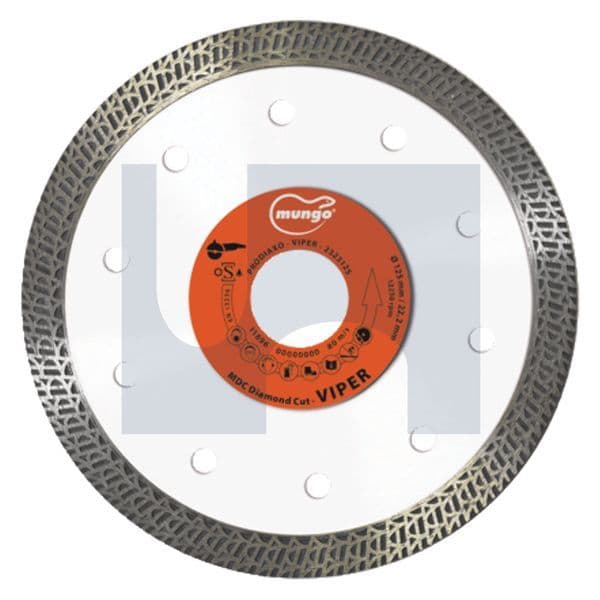
MDC Viper Diamond Blade
Mungo MDC Viper diamond cutting blade in 125 mm diameter with a 22.2 mm bore to suit standard angle grinders.
About the MDC Viper Diamond Blade
The Mungo MDC Viper is a superfine diamond blade for cutting ceramic wall and floor tiles dry with a 125mm angle grinder. It is 125mm with a 22.2mm bore, and on Mungo's compatibility chart it is the recommended blade for ceramic tile, sandware and natural quartz stone, basalt and porphyry, and well suited for granite, marble and terracotta tile. Natural stone only: do not cut engineered stone, including engineered 'quartz'. The guide below covers how it compares with the Cobra and Power M and safe dry cutting.
Also called tile blade for angle grinder, ceramic tile blade or superfine ceramic blade.
Features
- Mungo branded
- Diamond cutting blade
- 125 mm diameter
- 22.2 mm bore
- Suits standard angle grinders
Applications
- Cutting ceramic wall and floor tiles with a 125mm grinder
- Cutting terracotta tile
- Cutting granite and marble
- Cutting ceramic products
A superfine blade for ceramic tiles
Superfine is Mungo's word for the Viper's diamond rim, which Mungo says gives a high cutting speed and silent working. Distributed by Hobson, it is a dry blade for angle grinders (Mungo: grinding machines), oSa certified and listed by Mungo as complying with EN 13236.
Mungo's applications for it are sandware and ceramic products, so it is the Mungo blade to reach for when cutting ceramic wall and floor tiles with a 125mm grinder. Its diamond layer is 1.4mm wide, the narrowest of the 125mm Mungo blades on the data sheet (Laser Beton 2.2mm, Performer 2.4mm, Cobra 2.5mm, Power M 2.6mm).
Viper blade size: 125mm with a 22.2mm bore
The Viper comes in one size, for 125mm angle grinders. Match the blade to your grinder and its guard. Select the row to open it in the selector.
MDC Viper size. Diameter x bore from the selector; diamond layer width and height (Mungo: width and height of layer) from Mungo's data sheet. One blade per box. Tap a number to show it in the selector above.
| Diameter | Bore | Layer width | Layer height | Suits |
|---|---|---|---|---|
| 125mm | 22.2mm | 1.4mm | 10mm | 125mm angle grinders |
What it cuts: Mungo's compatibility chart
Where the Viper sits on Mungo's three-step chart (recommended, well suited, suitable):
- Recommended: ceramic tile, sandware, and natural quartz stone, basalt and porphyry (natural stone only: do not cut engineered stone, including engineered 'quartz').
- Well suited: granite, marble and terracotta tile.
- Suitable: ceramic products, concrete tile and clay tile.
- Not rated for: reinforced concrete, brick, clinker and vertically perforated (cored) brick, sand-lime brick, sandstone, aerated concrete (Ytong), cement fibre board, pebble stone plates, concrete agglomerate or facade elements. Use the Power M for concrete and brick.
- Mungo's chart does not list porcelain tile by name. Ask us before choosing a blade for porcelain.
Viper, Cobra or Power M?
- MDC Viper: the Mungo blade for ceramic wall and floor tiles. Recommended for ceramic tile and sandware; 125mm only, for angle grinders.
- MDC Cobra: the Mungo blade for roof tiles and stone. Recommended for concrete and clay roof tiles, ceramic products, granite, marble and natural quartz stone (natural stone only: do not cut engineered stone, including engineered 'quartz'); well suited for ceramic tile. 125 and 230mm, for grinders and wall chasers.
- MDC Power M: the concrete and masonry blade, recommended for reinforced concrete and brick. Mungo does not rate it for ceramic tile, sandware, marble or sandstone. 125 and 230mm.
- Concrete tile and clay tile: Mungo rates the Viper only suitable; the Cobra is the recommended one.
- Sandstone: the Viper is not rated for it; Mungo rates the Cobra and Laser Beton as suitable.
Cutting tiles safely with the Viper
Mungo's sheet gives no speed figure, so go by the maximum speed marked on the blade. The steps below are general good practice for any diamond blade on an angle grinder.
- With the grinder unplugged, fit the Viper with the guard on and its rotation arrow matching the grinder.
- Never fit it to a grinder that runs faster than the speed marked on the blade.
- Cut dry and let the blade work at its own pace, without twisting or side-loading it.
- Lay the tile flat and supported on both sides of the cut so it cannot pinch the blade or snap off mid-cut.
- Wear eye, hearing and respiratory protection. Dry cutting tiles, stone and other materials that contain crystalline silica makes respirable silica dust, so use on-tool extraction and a P2 or better respirator as Safe Work Australia's silica guidance requires.
- A cracked or out-of-round blade, or one with its diamond rim worn away, goes in the bin.
Natural stone, not engineered stone
Engineered stone (including benchtops sold as "quartz") is off limits for this and every blade: Australia prohibited its manufacture, supply, processing and installation from 1 July 2024 (Safe Work Australia), and existing engineered stone may be worked only under strict controls. Mungo's quartz, basalt, porphyry, granite and marble ratings are for natural stone.
Tile blades for angle grinders in Adelaide
Mungo tile blades, grinding discs and drill bits go out from Allmat to tilers, renovators, stonemasons, builders and trade across Adelaide and South Australia. Add the Viper to a quote with the rest of your list.
Viper blades for tile and ceramic cutting
Mungo diamond blades, grinding discs and cutting discs are available to order from Allmat for tilers, bathroom and kitchen renovators, stonemasons, builders and trade across Adelaide and South Australia. Order through Allmat, we pick and pack it, then click and collect from the Allmat yard or have it delivered to site.
Goes with
Questions
What is the MDC Viper blade used for?
Dry cutting ceramic tiles and ceramic products with a 125mm angle grinder. Mungo rates it as recommended for ceramic tile, sandware and natural quartz stone, basalt and porphyry (natural stone only: do not cut engineered stone, including engineered 'quartz'), and well suited for granite, marble and terracotta tile.
Can I cut tiles with an angle grinder?
Yes, with a diamond blade made for tiles, such as the Viper on a 125mm grinder. Clamp or support the tile, check the blade's marked maximum speed against the grinder, control the silica dust and wear eye, hearing and respiratory protection.
Viper or Cobra for tiles?
For ceramic wall and floor tiles, the Viper is Mungo's recommended blade and the Cobra is rated well suited. For concrete and clay roof tiles, granite and marble, the Cobra is the recommended one.
Is the Viper a wet or dry blade?
A dry blade. Mungo's sheet says no water cooling.
What size is the Viper blade?
125mm diameter with a 22.2mm bore, for 125mm angle grinders. It is the only size, one blade per box.
Will the Viper cut concrete or brick?
No. Mungo does not rate it for reinforced concrete, brick or masonry (it is rated suitable only for concrete and clay tiles). Use the MDC Power M, Mungo's recommended blade for reinforced concrete and brick.
Where can I buy a tile blade for an angle grinder in Adelaide?
Order through Allmat. Order ahead by phone on 1300 03 03 63 or send your list for a quote, then click and collect from 25 Kapara Road, Gillman, or have it delivered to site.
MDC Viper Diamond Blade: sizes and finishes we supply
1 line by finish. Pick one above for its product code and pack sizes.
| Type | Diameter (mm) | Bore (mm) | Lines |
|---|---|---|---|
| Diamond Blade | 125 | 22.2 | 1 |
Data sheets and documents
The documents for the product you choose are listed with the selector above. Here is every MDC Viper Diamond Blade document from Hobson Engineering.
All MDC Viper Diamond Blade documents (4)
Data sheets and technical data (2)
Guides and articles (2)
Need them in bulk?
Add the sizes you need to your quote, or send us your list and we’ll price the lot and supply it with the rest of your order.
Browse all abrasives & cutting