Working Load Limit
Quick answer
WLL, SWL and breaking load in one minute
WLL (working load limit) is the load the manufacturer rates and marks on lifting gear for one stated way of loading. It already has the safety factor built in. Breaking load is far higher and is never a figure to work to. Change the hitch or the angle and the capacity changes, and only gear marked with a WLL is lifting gear.
What does WLL mean?
WLL stands for working load limit: the load-bearing capacity the manufacturer rates a piece of lifting gear for, and marks on it, for a stated way of loading.
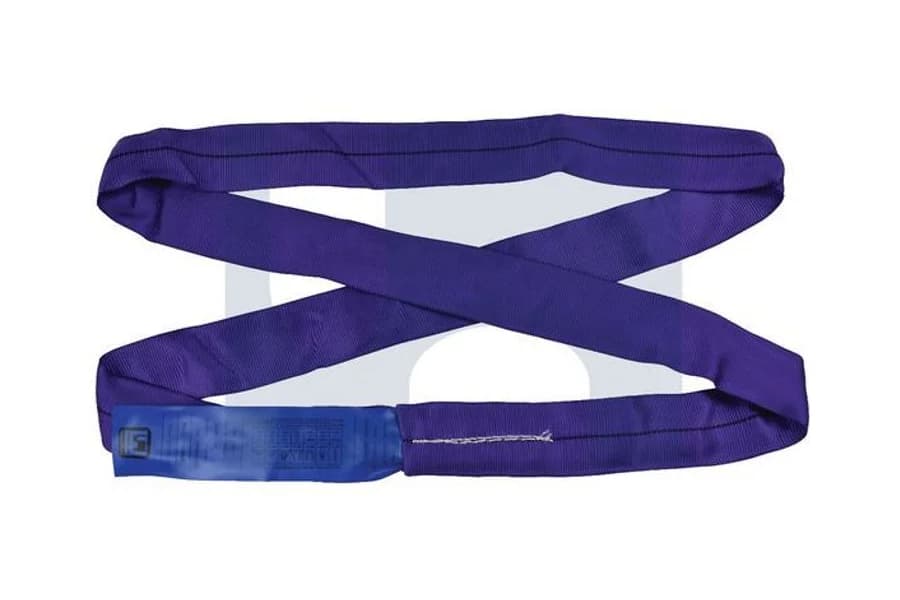
A sling's tag WLL is for a straight vertical lift. An eye bolt's stamped WLL is for an axial pull, straight in line with the thread.
The manufacturer's sling sheets say not to use a sling if its WLL tag has been removed.
What the markings tell you
On the rated lifting gear in our range, the WLL sits alongside the other markings the data sheets list: CE (European Conformity), the size or grade, the manufacturer's mark and, on most items, a trace code linked to the item's test certificate online.
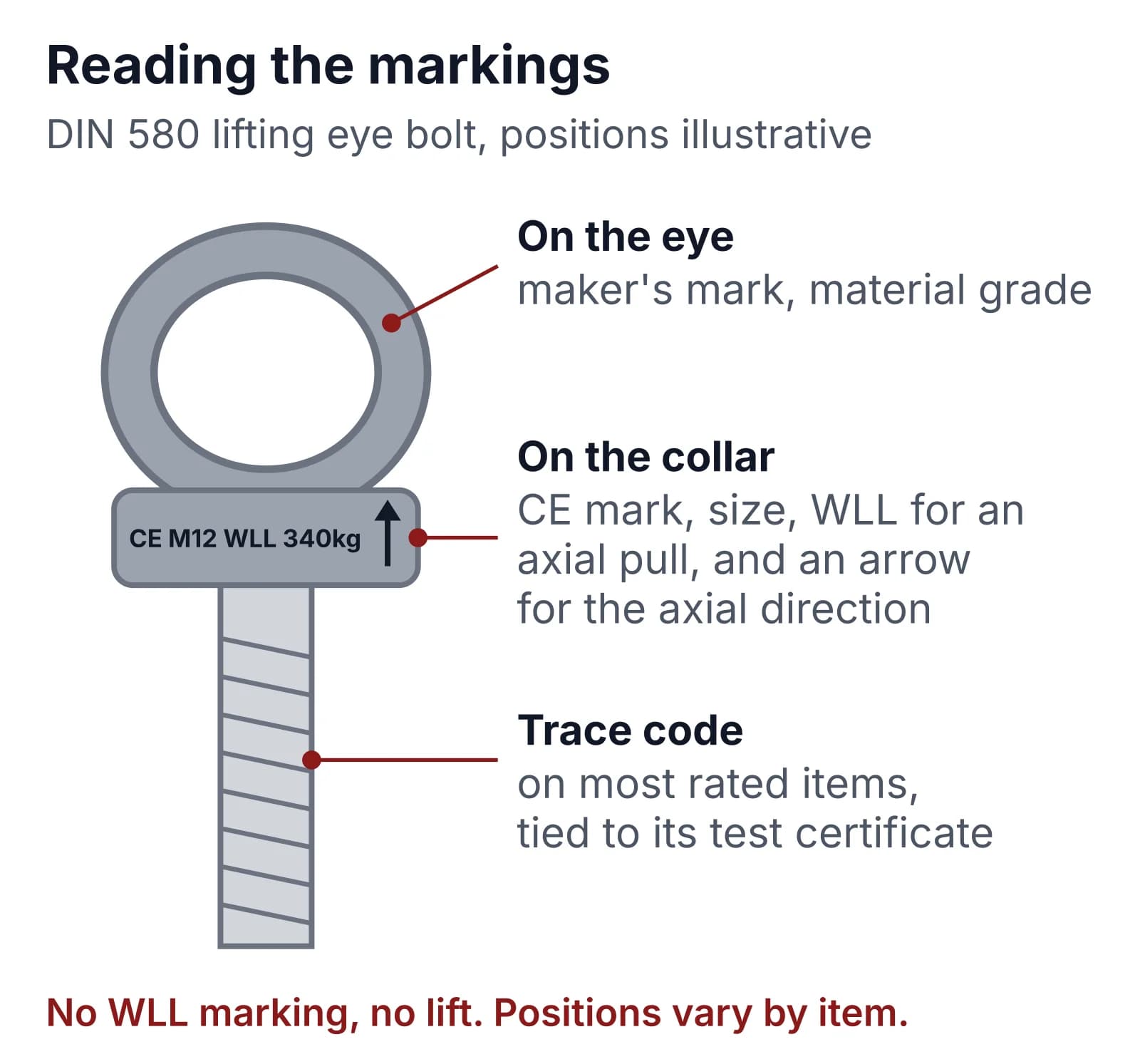
Markings as listed on the manufacturer's DIN 580 eye bolt data sheet and material handling guide. Positions are illustrative: the sheet lists the markings, not where each one sits.
SWL vs WLL vs minimum breaking load
WLL (working load limit): the rating the manufacturer marks on the gear for a stated way of loading. Every data sheet for the lifting gear in our range uses it.
SWL (safe working load): another term you may see on gear and in documents. The lifting gear data sheets in our range do not use it. If an item is marked with an SWL, go by its maker's documentation rather than assuming it equals a WLL.
Breaking load: the load at which the item fails, sometimes given as a minimum breaking or minimum ultimate tensile load. It is far higher than the WLL and never a figure to work to.
One data sheet shows the gap: the zinc plated M12 DIN 580 lifting eye bolt has a WLL of 340kg in an axial pull and a minimum ultimate tensile load of 20.0kN. 340kg is about 3.3kN, so the breaking figure is around six times the WLL.
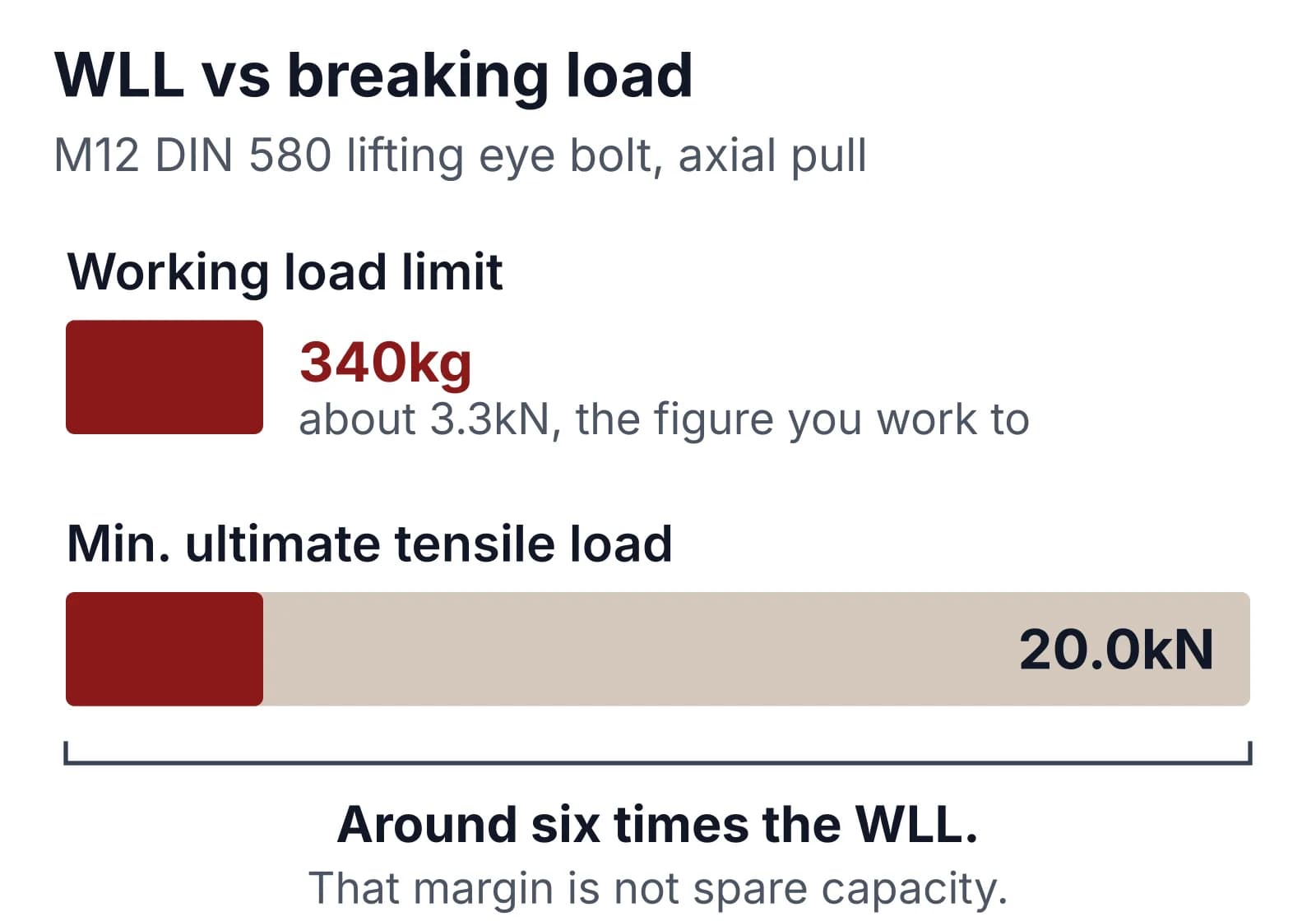
Figures from the manufacturer's data sheet for the zinc plated M12 lifting eye bolt.
Safety factors: where they come from
The manufacturer states the factor each item is made or tested to. It is already built into the WLL on the tag; a proof test is a test load, not a working load.
Round slings: 7:1
Made with a 7:1 safety factor, to EN 1492-2 and the performance requirements of AS 4497.
Round slings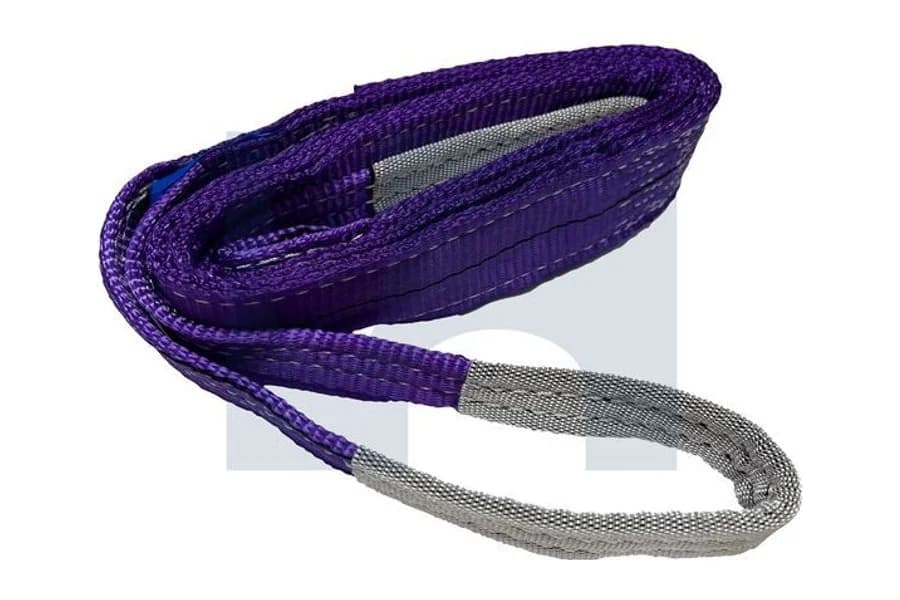
Flat slings: 8:1
Made with an 8:1 safety factor, to EN 1492-1 and the performance requirements of AS 1353.1.
Flat slings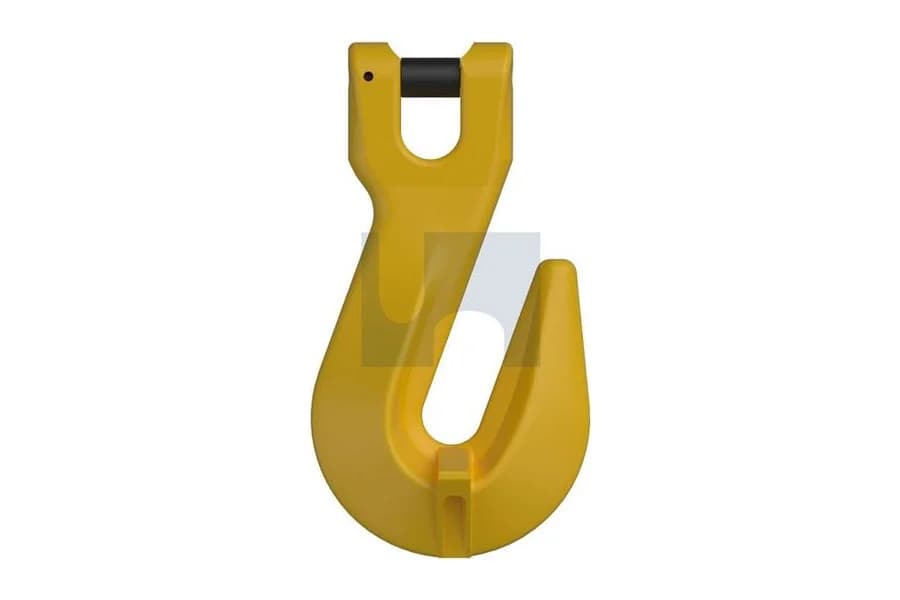
Clevis grab hooks: proof tested at 2.5 WLL
The sheets state individual proof testing at 2.5 times WLL for the Grade 80 clevis grab hooks and the master links, and fatigue testing at 1.5 times WLL for 20,000 cycles for the grab and eye sling hooks. Not every hook or link carries these claims.
Grade 80 clevis grab hooksThe hitch changes the WLL: vertical, choke and basket
From the manufacturer's round sling capacity chart, for the 1,000kg (violet) sling. The chart runs the same pattern for every rating from 1,000kg to 10,000kg.
For any configuration not on the chart, the manufacturer says to consult its engineering team before lifting.
See the full charts on our round sling and flat sling pages, and the round sling data sheet.
Why the angle matters: basket hitches and the 60 degree rule
In a basket hitch, the sling's two legs run up from the load to the hook. The chart's angle is the angle between those two legs (the included angle), not the angle from vertical. As it widens, the capacity drops. The manufacturer's flat sling chart shows it for the 1,000kg sling.
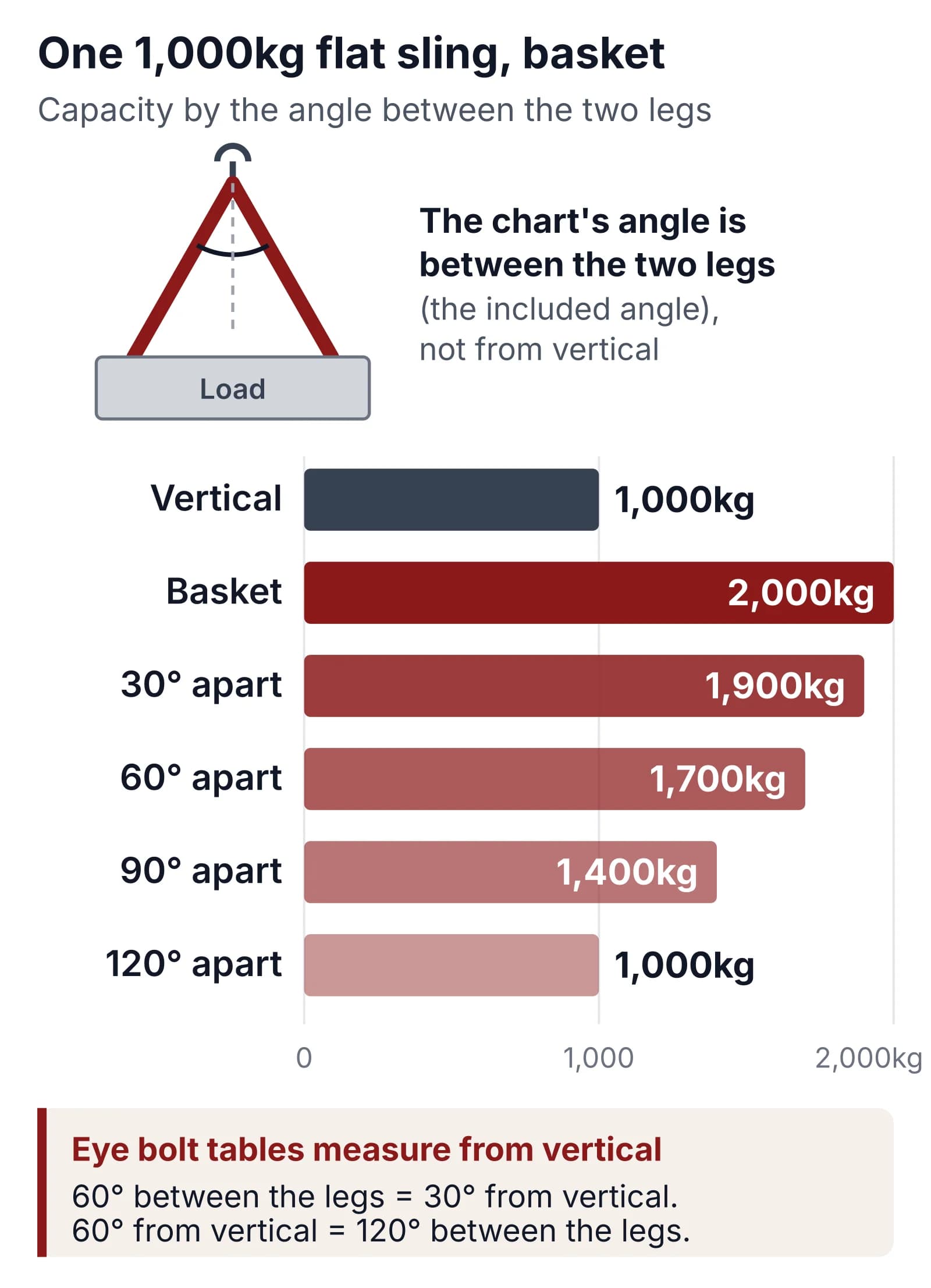
The basket and angle columns of the manufacturer's flat sling capacity chart. Each angle is measured between the two legs of the basket.
The manufacturer's lifting shackle sheets put the same idea as a rule: the WLL should be reduced where the angle between slings exceeds 60 degrees, and with multi-leg slings, consideration should be given to the angle between the legs.
Bow shackles connecting two slings are assembled with the slings in the shackle body and the hooks on the pin.
See the shackle WLL tables on our lifting shackles page and the lifting bow shackle data sheet.
Watch the angle
Two ways to measure the angle
The sling chart above measures the angle between the two legs. Lifting eye bolt and eye nut tables measure each leg from vertical. 60 degrees between the legs is 30 degrees from vertical, and 60 degrees from vertical is 120 degrees between the legs, where the 1,000kg flat sling's chart is down to 1,000kg. Check which one a table uses before you read a figure from it.
Lifting eyes: the angle is measured from vertical
A DIN 580 lifting eye bolt or DIN 582 eye nut is stamped with its WLL for an axial pull. Pull at an angle and the capacity per eye drops. Unlike the sling chart, these tables measure the angle from vertical, for each leg. For the zinc plated M12 lifting eye bolt:
Axial: 340kg.
Leg 0 to 45 degrees from vertical: 240kg per eye bolt.
Leg over 45 to 60 degrees from vertical, or bolts fitted at the sides of the load (0 to 45 degrees): 170kg per eye bolt.
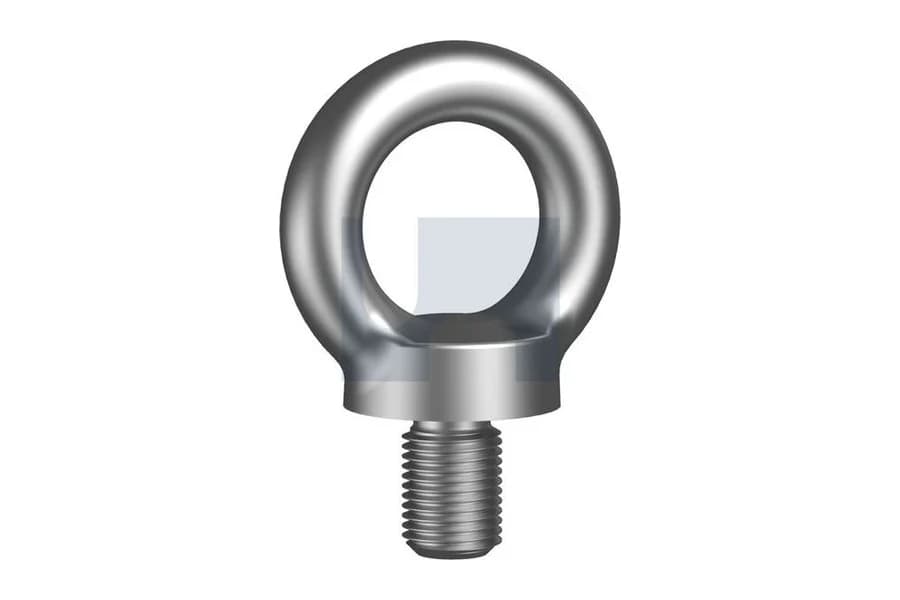
The manufacturer's tables stop at 60 degrees from vertical, so do not load a DIN 580 or DIN 582 eye at a wider angle. Every size and angle is on our DIN 580 lifting eye bolt and DIN 582 lifting eye nut selections.
Planning a lift and not sure what gear it needs? Contact us with the load and how it will be slung, and we will match rated gear to it.
Only marked gear is lifting gear
| Feature | Rated lifting gear | General hardware |
|---|---|---|
| Marked with a WLL | ✓ | ✗ |
| Approved for lifting on the manufacturer's data sheet | ✓ | ✗ |
| Made to a lifting standard (for example DIN 580, DIN 582, AS 2741) | ✓ | ✗ |
| Use for lifting | ✓ | ✗ |
Rated for lifting
Made to a lifting standard and marked with a WLL.
DIN 580 lifting eyes
Eye bolts made to DIN 580, WLL stamped for an axial pull.
View the range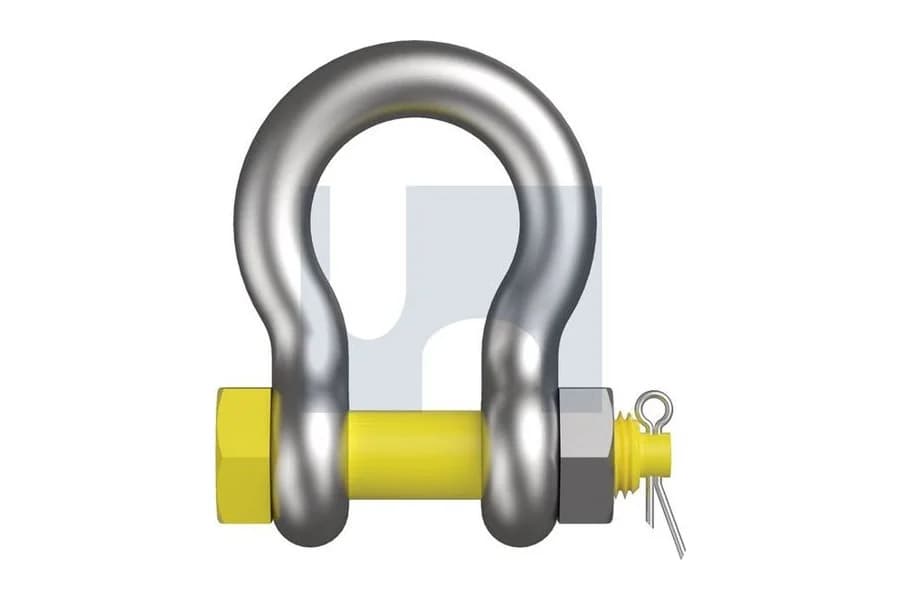
Lifting shackles
Grade S, made and marked to AS 2741.
View the range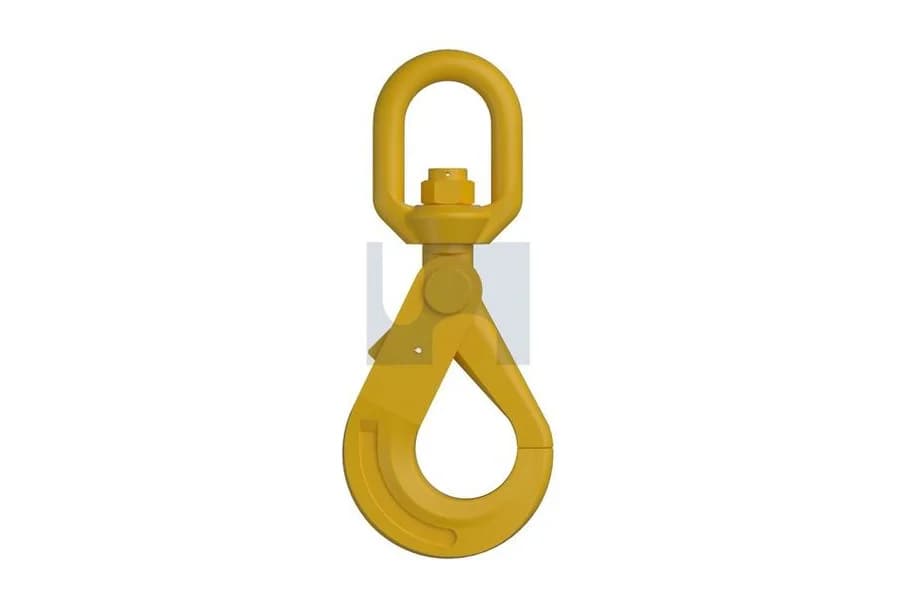
Grade 80 hooks
Grade 80, each marked with its WLL and a trace code.
View the range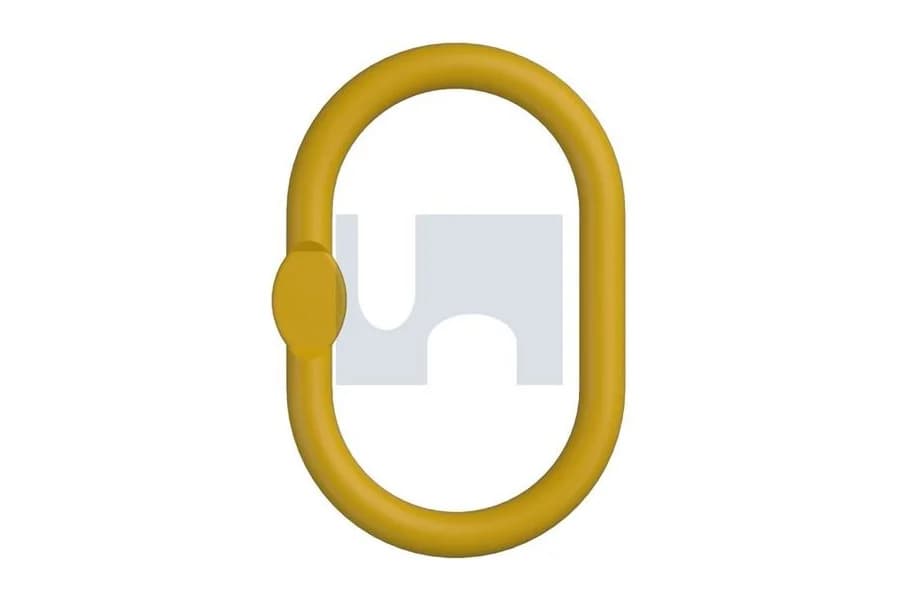
Grade 80 chain links
Master and connecting links; the master links are individually proof tested at 2.5 times WLL.
View the rangeNot lifting gear
These look similar but carry no WLL, or a different rating altogether.
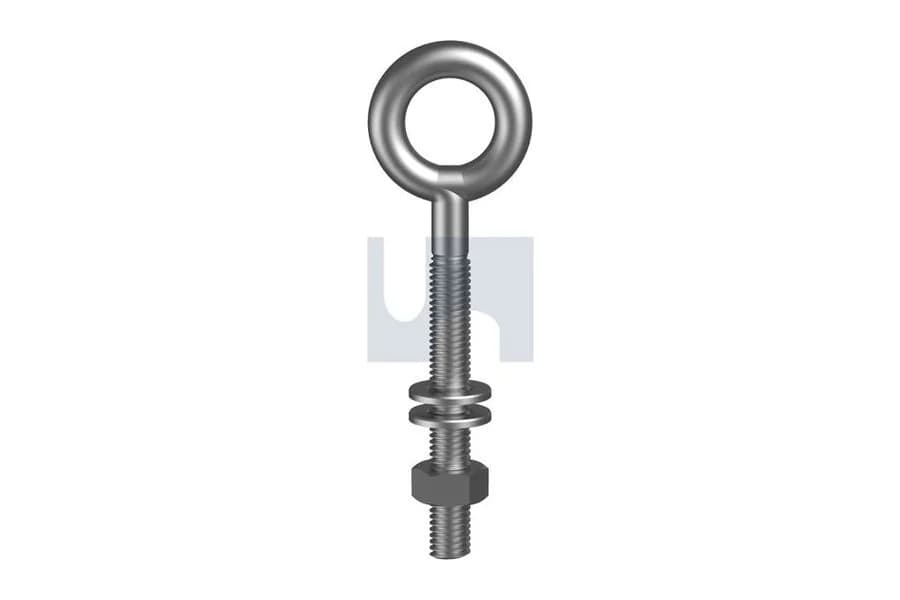
General purpose eye bolts
No WLL, not rated for lifting.
View the range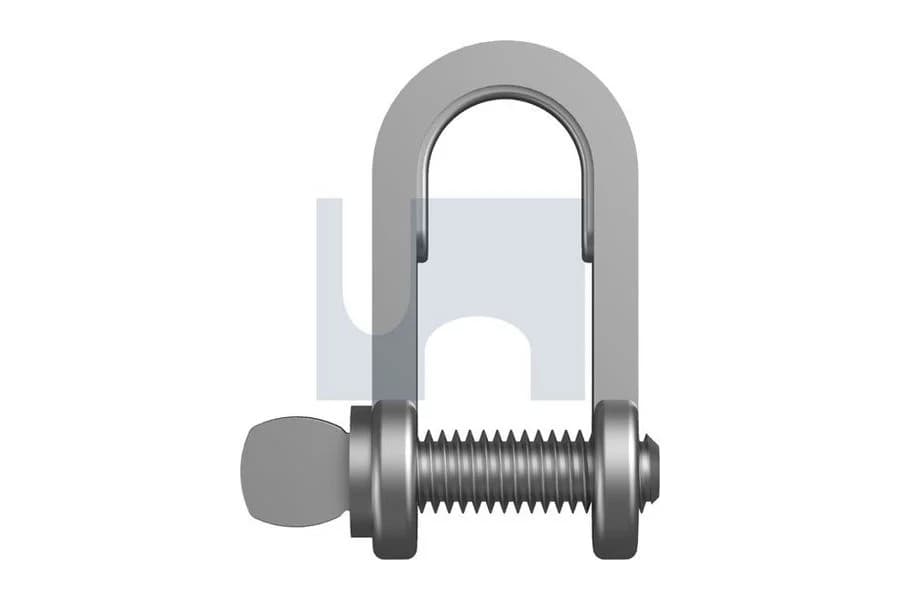
Stainless steel d shackles
General hardware: no WLL, not rated for lifting.
View the range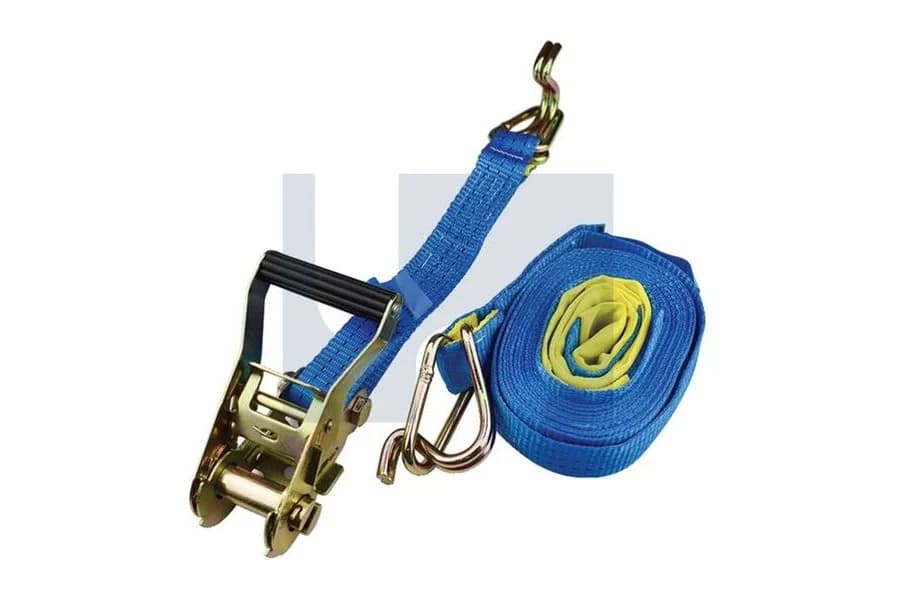
Ratchet tie downs
Lashing capacity (LC) to AS/NZS 4380 for load restraint. The sheets say not to be used for lifting; see the Load Restraint Guide at ntc.gov.au.
View the rangeCheck it before every lift
The checks the manufacturer's sheets give for slings and shackles.
Slings
- Inspect for damage between each use
- Do not use with cut webbing or snagging
- Do not use with heat or chemical damage
- Do not use with the WLL tag removed
- Do not tie knots in it
- Protect it from sharp edges with protective sleeves
- Keep it below 90 degrees C
- Keep it away from abrasive grit, strong alkalis and phenolic compounds
- Consult the manufacturer before immersing it in a chemical solution
Shackles
- Use within -10 to 200 degrees C
- Check the pin is the correct one, screwed fully home
- Fit the safety pin on safety pin shackles
- Never swap a pin for one of a different grade or size
- Remove bent, overly tight fitting or misaligned shackles from service
- Avoid lifts where the load can roll and unscrew the pin
Formal inspection intervals, and who may carry them out, are set by the rules and standards that apply to your workplace. The manufacturer's sheets cover the checks before use.
Where to next
Every rated item and its WLL table is in our lifting equipment range. Order through Allmat: we pick and pack it, then you click and collect from the Allmat yard or we deliver to site.
Working load limit questions
WLL stands for working load limit. It is the load-bearing capacity the manufacturer rates and marks on a piece of lifting gear for a stated way of loading it, such as a straight vertical lift for a sling or an axial pull for an eye bolt. Work within the WLL for the way the gear is actually being used.
Do not assume so. SWL (safe working load) is another term you may see on gear and in documents, but the data sheets for the lifting gear in our range rate and mark it by WLL. If an item is marked with an SWL, go by its maker's documentation for what that figure means.
Breaking load is the load at which the item fails; WLL is the much lower figure you work to. For example, the manufacturer gives an M12 DIN 580 lifting eye bolt a WLL of 340kg in an axial pull and a minimum ultimate tensile load of 20.0kN, around six times the WLL. That margin is not spare capacity to use.
It is the safety factor the manufacturer states its round slings are made with (its flat slings are made with 8:1). It is already allowed for in the WLL on the tag, which is why the tag WLL, adjusted for the hitch and angle on the capacity chart, is the figure to work to.
Yes. For the 1,000kg flat sling in a basket hitch, the manufacturer's chart gives 1,900kg with 30 degrees between the two legs, 1,700kg at 60 degrees, 1,400kg at 90 degrees and 1,000kg at 120 degrees. Its shackle sheets say the WLL should be reduced where the angle between slings exceeds 60 degrees. Eye bolt and eye nut tables measure the angle differently, from vertical: 60 degrees from vertical is 120 degrees between two legs.
No. The general purpose eye bolts and the stainless shackles in our hardware range carry no WLL and are not rated for lifting. Use lifting eye bolts made to DIN 580, eye nuts to DIN 582, and lifting shackles made to AS 2741, each marked with its WLL.
LC is the lashing capacity, the rating for restraining a load during transport to AS/NZS 4380. It is not a lifting rating: the manufacturer's tie-down sheets say the straps are not to be used for lifting, and refer you to the Load Restraint Guide at ntc.gov.au.
It is a test load. The manufacturer's sheets state it for its Grade 80 clevis grab hooks and its Grade 80 and Grade 100 master links: each is individually proof tested at 2.5 times its WLL. Its Grade 80 eye grab hooks, eye sling hooks and clevis grab hooks are also fatigue tested at 1.5 times WLL for 20,000 cycles. Those tests show the item's quality; they are not loads to work to, and they are not claimed for every hook or link.
Sources
Every figure in this guide is quoted from the manufacturer's documents. Nothing here replaces the data sheet for the item you are using, the markings on it, or the rules for your workplace.
Polyester Round Sling data sheet and capacity chart
Flat Sling 2 Ply Protected Eye data sheet
Lifting Eye Bolt DIN 580 (zinc plated) data sheet
Lifting Bow Shackle Safety Pin data sheet
Grade 80 hook range (Did You Know)
Grade 80 master link (Did You Know)
Grade 100 master link (Did You Know)
Material Handling product guide
Ratchet Tie Down data sheet
Get the Right Lifting Gear
Tell us what you are lifting and how, and we will match rated slings, shackles, hooks and lifting points to the job.