
Fastener Finishes
Quick answer
Zinc plated, galvanised or stainless?
Zinc plated (about 5 µm of zinc) is for indoors and non-corrosive spots. Hot dip galvanised (50 µm) is for long term outdoor work. Stainless steel has no coating to wear away; 316 is the step up near the sea and within 2m of a pool. The right finish comes down to the corrosion zone and whether the fixing is enclosed, sheltered or exposed.
What is the difference between zinc plated, galvanised and stainless?
Zinc plated fasteners carry a thin electroplated zinc coat, about 5 micrometres (µm). The manufacturer recommends them for indoor and non-corrosive environments.
Hot dip galvanised (HDG) fasteners carry a much heavier zinc coat, 50 µm to AS/NZS 1214, and are recommended for long term outdoor use.
Stainless steel has no coating to wear away: its corrosion resistance comes from the metal itself, and 316 is the step up from 304 near the sea and around pools.
Which one a job needs comes down to two questions: how corrosive is the area (the corrosion zone), and is the fixing enclosed, sheltered or exposed to the weather?
Zinc plated vs galvanised at a glance
| Feature | Zinc plated | Hot dip galvanised |
|---|---|---|
| Electroplated zinc, about 5 µm (ISO 4042) | ✓ | ✗ |
| Zinc coating of 50 µm (AS/NZS 1214) | ✗ | ✓ |
| Rated "high" corrosion resistance on the coatings chart | ✗ | ✓ |
| Recommended for long term outdoor applications | ✗ | ✓ |
| Recommended for indoor and non-corrosive environments only | ✓ | ✗ |
Coating thickness is the number to compare
The finishes below are on the manufacturer's coatings chart for bolts, screws, nuts, washers and anchors, plus the Z275 used on sheet steel connectors.
The Galvanizers Association of Australia technical bulletin quoted in the manufacturer's galvanising article says the brightness of a galvanised coating has no effect on its performance in service; what counts is the coating mass, and the heavier the coating, the longer its life.
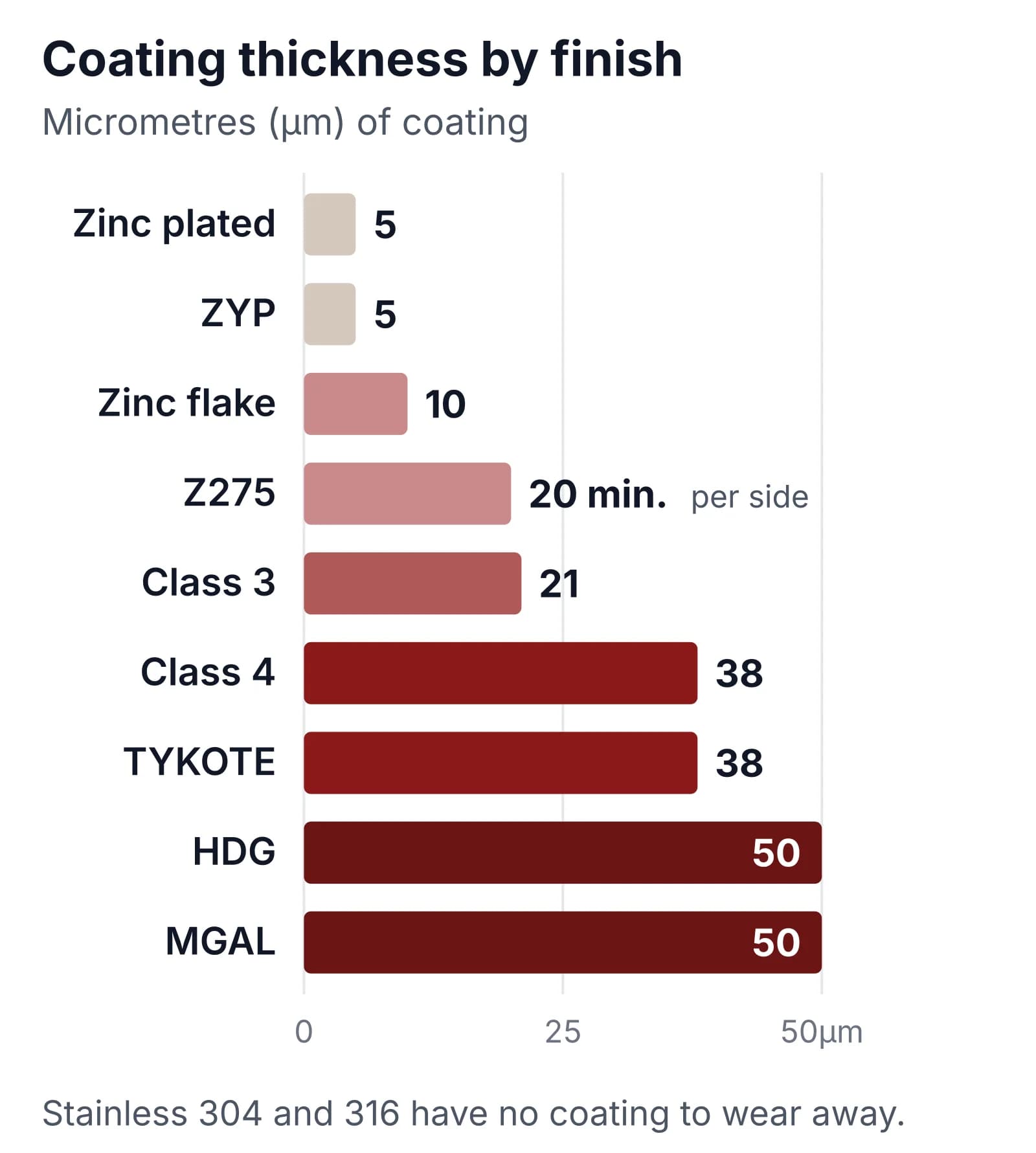
Thicknesses from the manufacturer's coatings chart; Z275 from its galvanised connector sheet (275 grams of zinc per square metre).
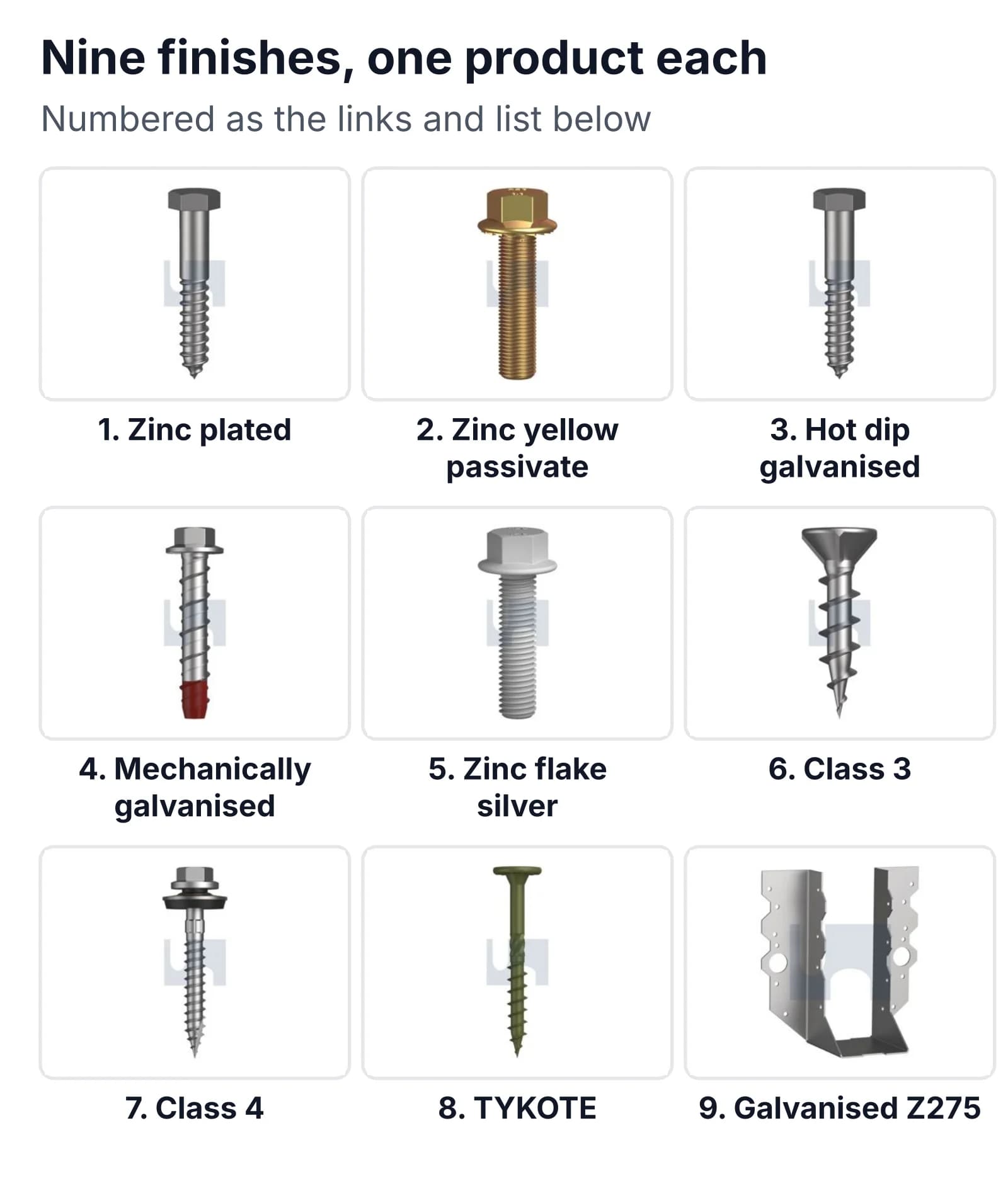
One real product in each finish. The numbered links below open each one.
The finishes compared
From zinc plated to galvanised screws and bolts, in the same order as the photos. Thickness, standard, then what the manufacturer rates it for.
Finish by finish
1. Zinc plated (Z/P)
- Electroplated zinc, clear passivate, 5 µm, ISO 4042
- Low corrosion resistance: indoor and non-corrosive environments
2. Zinc yellow passivate (ZYP)
- Electroplated zinc, yellow passivate, 5 µm, ISO 4042
- More resistant than Z/P: low-corrosion environments or temporary fixing
3. Hot dip galvanised (HDG)
- 50 µm, AS/NZS 1214
- High: long term outdoor applications
4. Mechanically galvanised (MGAL)
- 50 µm, ISO 12683
- Similar to HDG, better abrasion resistance, no risk of hydrogen embrittlement
5. Zinc flake silver (ZFS)
- 10 µm, ISO 10683
- High, no risk of hydrogen embrittlement; thin enough that a zinc flake bolt fits a standard nut without over-tapping
6. Class 3 (self-drilling screws)
- Mechanically galvanised, 21 µm, AS/NZS 3566.2
- Moderate: external use in ISO 9223 categories C2 and C3
7. Class 4 (self-drilling screws)
- Mechanically galvanised, 38 µm, AS/NZS 3566.2
- High: severe marine environments, category C4
8. TYKOTE
- 38 µm proprietary coating, rated high
- Specially formulated for resisting treated pine chemicals
9. Galvanised Z275 (connectors)
- Sheet steel for joist hangers, triple grips and multi grips
- At least 275 g of zinc per square metre, at least 20 µm per side
Stainless steel 304 and 316
Stainless has no coating at all, so there is nothing to wear through. Its corrosion resistance comes from the steel itself.
316 adds molybdenum for better resistance to salt. See 304 vs 316 stainless for which grade suits where.
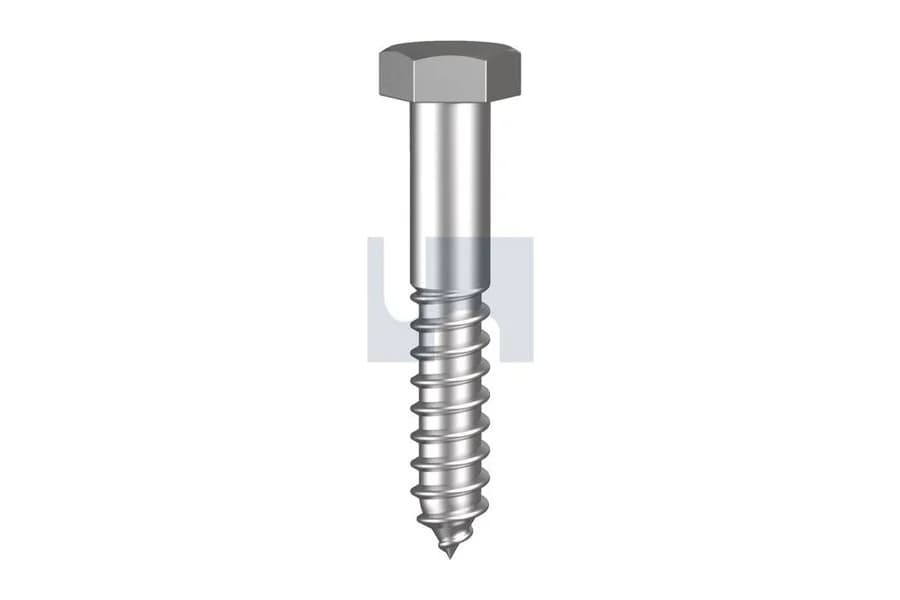
Does galvanised steel rust?
Eventually, yes. Galvanising puts zinc between the steel and the weather, and the zinc itself corrodes slowly instead of the steel.
The manufacturer's corrosion guide gives one-year corrosion rates for each ISO 9223 category. So the thicker the zinc, the longer it lasts, and once it is used up the steel underneath starts to rust.
One-year corrosion rates
Micrometres lost per year, from the manufacturer's corrosion guide.
Zinc vs bare mild steel
Zinc
- C1 dry indoors: under 0.1 µm
- C3 coastal or industrial: 0.7 to 2.1 µm
- C4 sea-shore: 2.1 to 4.2 µm
Bare mild steel
- C3: 25 to 50 µm
- C4: 50 to 80 µm
A dull grey bolt is not rusting
The Australian Stainless Steel Development Association (ASSDA) describes the sequence for galvanised steel: slow general corrosion until the zinc dissolves, then red rust as the zinc-iron layer corrodes, and finally the steel itself.
Where the coating is scratched, the surrounding zinc protects the exposed steel.
A new galvanised bolt that turns dull grey is not rusting. That matt grey is the zinc reacting with the air, and the Galvanizers Association of Australia says it has no effect on performance.
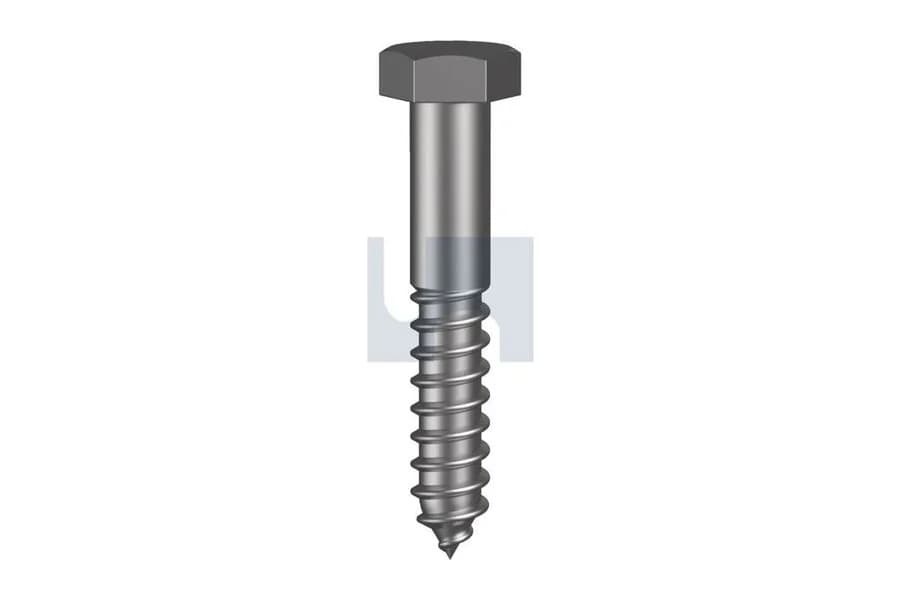
Corrosion zones explained: C1 to C5 and CX
AS 4312 and ISO 9223 group sites into atmospheric corrosivity categories. The manufacturer's corrosion guide sets out the typical environments for each one, mostly by distance from the sea.
C1, very low
Dry indoors, such as heated or air-conditioned commercial buildings.
C2, low
Arid or urban inland. Most areas of Australia 50km from the coast; 3 to 6km from a less sheltered bay or gulf; within 1km of quiet, sheltered seas.
C3, medium
Coastal or industrial. 1 to 10km inland along ocean-front areas with breaking surf and significant salt spray (maybe extended to 50km inland with prevailing winds and local conditions); from 100m to 3 to 6km inland for a less sheltered bay or gulf; 50m to 1km inland around sheltered bays.
C4, high
Calm sea-shore. 200m to 1km inland in areas with rough sea and surf (maybe extended inland with prevailing winds and local conditions); from the shoreline to 50m inland around sheltered bays; the immediate vicinity of calm salt water, such as harbour foreshores.
C5, very high
Aggressive industrial areas (C5-I), and within a few hundred metres of rough seas and surf beaches (C5-M), maybe extended inland with prevailing winds and local conditions.
CX, extreme
Ocean and offshore: surf beach shoreline regions with very high salt deposition.
Two things push a site up the scale: being closer to the salt, and wind. These descriptions are indicative only.
The designer or builder confirms the category for a site, and where a site sits on a boundary between two categories, the manufacturer's screw warranty applies the higher one.
What that means around Adelaide
Adelaide's metropolitan beaches face Gulf St Vincent, and the guide treats a less sheltered bay or gulf differently from a sheltered bay and from an ocean coast with breaking surf. Reading the metro coast as a gulf is our reading of the map, not a line from the guide, so your designer or builder confirms the category for your site.
On its distances, a less sheltered bay or gulf gives C3 from 100m out to 3 to 6km inland, then C2 beyond that. On an ocean coast with breaking surf, such as South Australia's Southern Ocean beaches, the bands reach much further: C3 from 1km to 10km inland (maybe 50km with prevailing winds), C4 from 200m to 1km, and C5 within a few hundred metres of the surf.
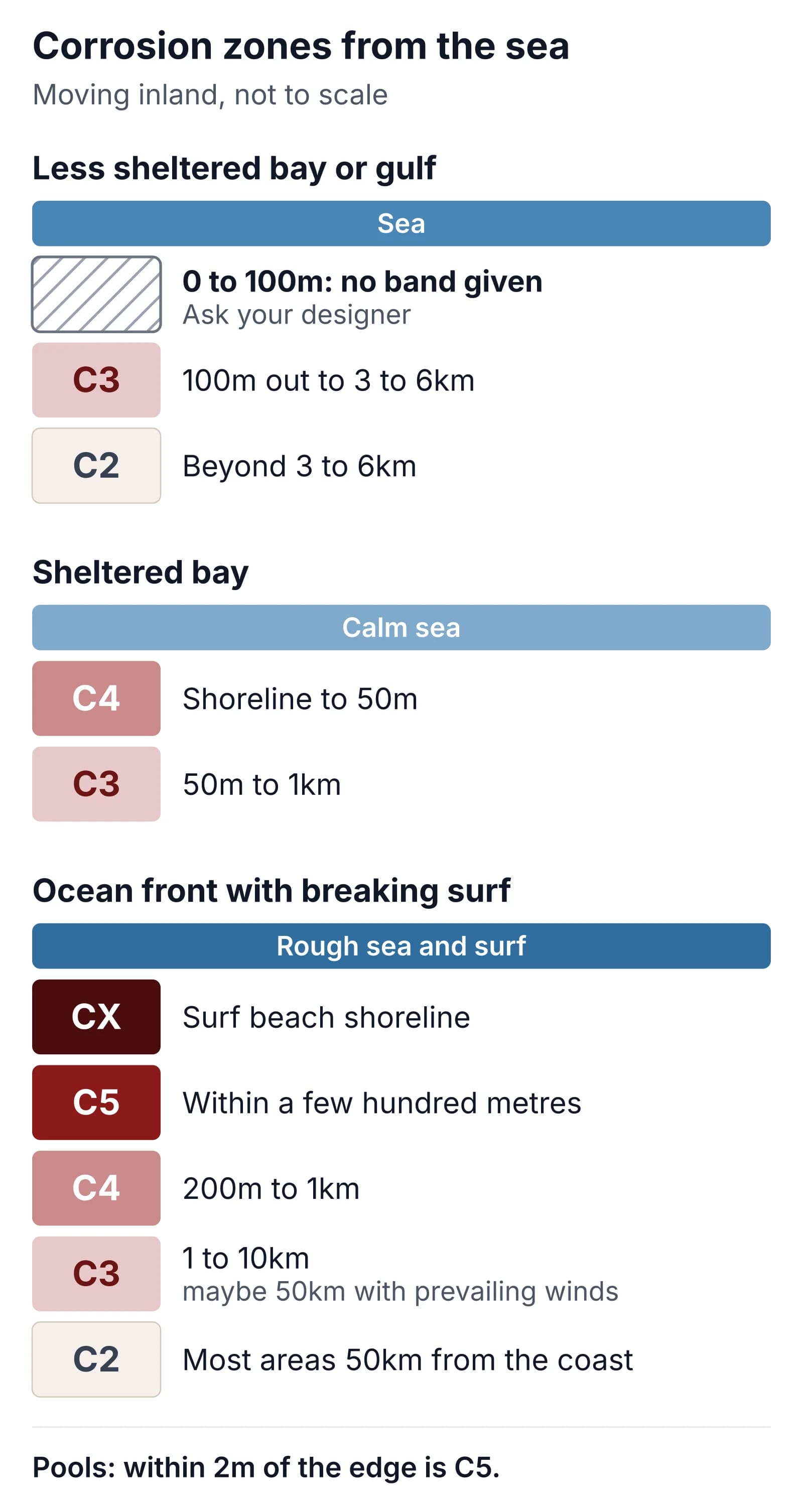
Bands from Table 2 of the manufacturer's corrosion guide, using its own descriptions of each setting. Rows run inland and are not to scale.
The guide does not give a separate band for the first 100m of a gulf foreshore; it lists the immediate vicinity of calm salt water, such as harbour foreshores, as C4, and around sheltered bays C4 runs from the shoreline to 50m inland. For a site on or near the waterfront, have the designer confirm the category.
We do not label suburbs as zones: wind, shelter and the site itself all move the line.
Pools are a zone of their own
Within 2m of a pool edge is the pool splash zone, category C5.
The guide calls for 316 stainless there whether the fixing is enclosed, sheltered or exposed.
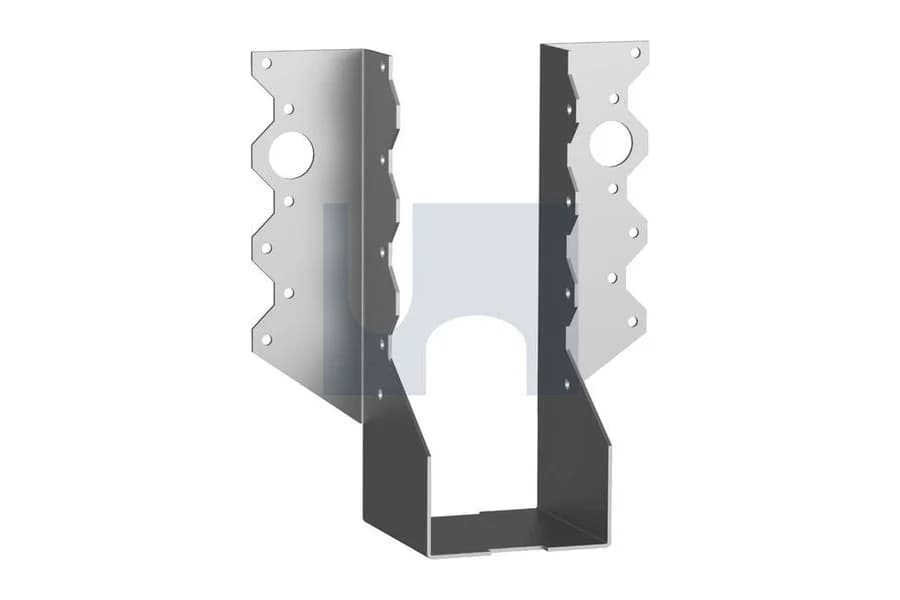
Enclosed, sheltered or exposed: why a deck is not a roof cavity
The second question is how much weather the fixing sees. The guide uses three exposure conditions.
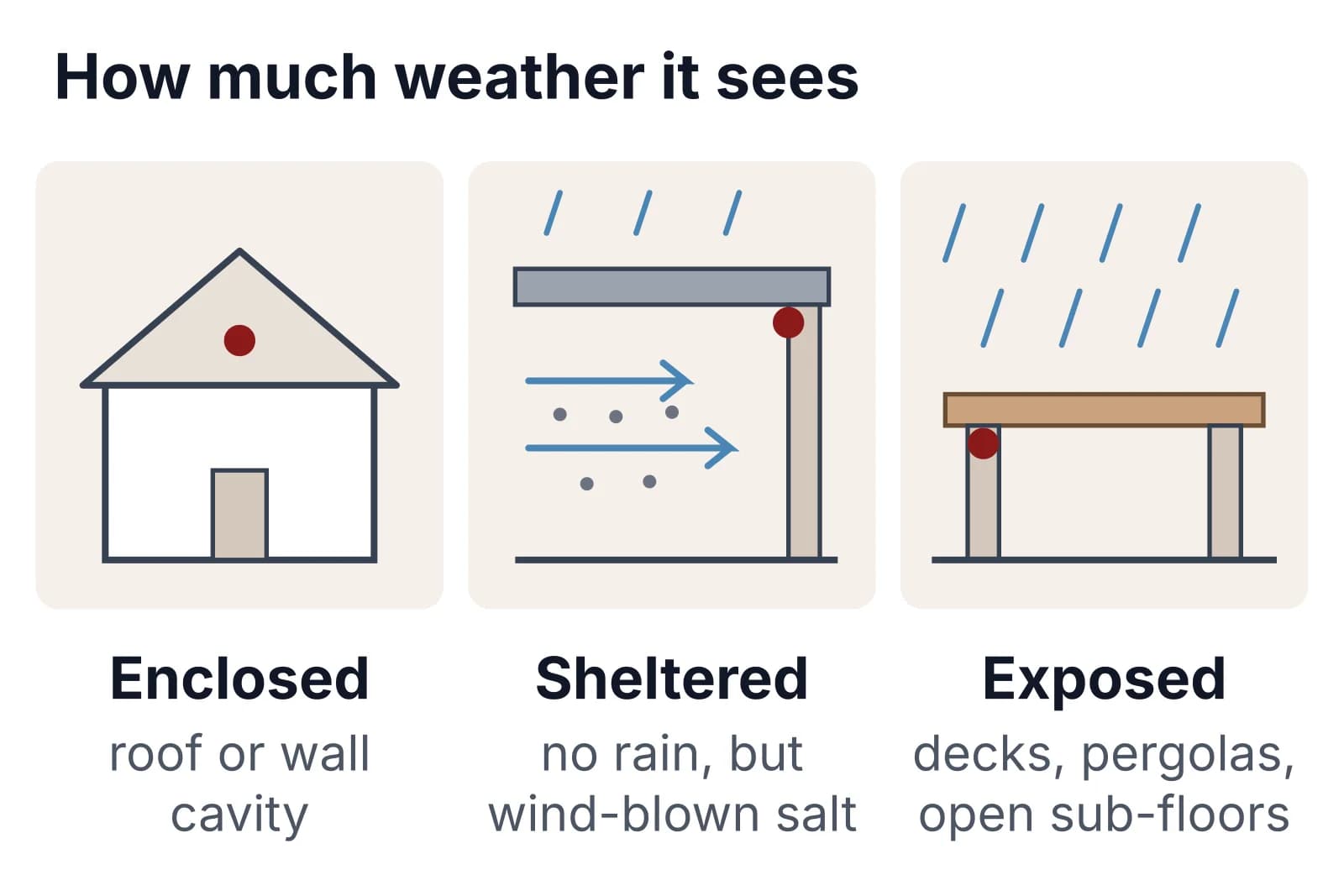
The three exposure conditions in the manufacturer's corrosion guide. The red dot is the fixing.
Enclosed: within a fully enclosed building envelope, such as a roof cavity behind sealed eaves or a wall cavity behind cladding or brickwork. (In seaspray areas the guide notes sarking is required under a tiled roof.)
Sheltered: not exposed to rain but subject to wind-blown salts, such as under an open balcony with no ceiling or in a sheltered, open garage.
Exposed: exposed to the weather and rain, such as decks, pergolas and open sub-floors.
A joist hanger in a roof cavity and a joist hanger on a deck can be a few metres apart and still need very different finishes. That is why our deck fixings guide starts with the finish.
Quick picker: minimum finish by zone and exposure
The manufacturer's minimum corrosion protection table for metal connectors such as strapping, bracing, framing connectors, joist hangers and truss plates. The same guide notes connectors are susceptible to atmospheric corrosion just as metal fasteners are.
Very low and low (C1, C2)
Enclosed: zinc plated. Sheltered: galvanised Z275. Exposed: stainless 304 or 316, or hot dip galvanising.
Coastal, medium (C3, C4)
Enclosed: galvanised Z275. Sheltered: Z275 with a soft seal coating or equivalent, or stainless 304 or 316. Exposed: stainless 304 or 316, or hot dip galvanising.
Industrial, high (C5, CX)
Enclosed: galvanised Z275. Sheltered: Z275 with a soft seal coating or equivalent, or stainless 304 or 316. Exposed: stainless 304 or 316, or hot dip galvanising.
Seaspray, high and very high (C4, C5, CX)
Enclosed: galvanised Z275. Sheltered and exposed: stainless 304 or 316.
Pool splash zone, within 2m of the pool edge (C5)
Stainless 316, enclosed, sheltered or exposed.
Not sure which finish your job needs? Contact us with what you are fixing and the zone your designer has given you, and we will match the fixings to it.
Roofing and self-drilling screw coatings by zone
For self-drilling screws, the manufacturer publishes a corrosion resistance and structural integrity warranty by ISO 9223 category: Class 3, Class 4, X9 and bi-metal. These are the manufacturer's warranty periods, not a promised service life.
Warranty years by category
Class 3
- C2: 20 years
- C3: 10 years
- C4, C5: not recommended
Class 4
- C2: 25 years
- C3: 20 years
- C4: 15 years
- C5: not recommended
X9 ProteXion
- C2: 30 years
- C3: 25 years
- C4: 20 years
- C5: not recommended
304 stainless bi-metal
- C2: 35 years
- C3: 25 years
- C4: 20 years
- C5: not recommended
316 stainless bi-metal (not in our range)
- C2: 40 years
- C3: 30 years
- C4: 25 years
- C5: 15 years
Read the terms with the table: CX sites are not covered unless the manufacturer confirms the site in writing before purchase; the warranty covers the structural integrity of the exposed head and washer, not staining or loss of colour; and it depends on correct installation and the washing below.
See the coatings available on our roofing screws, tek screws and decking screws pages.
Keep it clean: wash intervals by zone
Salt left on a fastener keeps it wet and corroding. As a condition of its self-drilling screw warranty, the manufacturer requires the fasteners and the surfaces around them to be washed down with fresh water:
C2 to C3: at least every six months.
C4 to C5: at least every three months.
Wash sooner whenever contamination is visibly building up. The Australian Stainless Steel Development Association (ASSDA) makes the same point for stainless near the coast: rain does the washing on open surfaces, and sheltered spots that rain never reaches, such as eaves and soffits, need washing most.
Stainless steel needs the same care near the sea. See does stainless steel rust? for why.
Where to next
Each product page shows the finishes it comes in: coach screws, coach bolts, hex bolts, joist hangers, post stirrups, galvanised plates and brackets, cyclone straps, Dynabolt-style sleeve anchors, masonry screw anchors, square washers and threaded rod.
Order through Allmat: we pick and pack it, then you click and collect from the Allmat yard or we deliver to site, with the timber and the rest of your order.
Fastener finish questions
No. Zinc plating is a thin electroplated zinc coat, about 5 micrometres, and the manufacturer rates it low for corrosion resistance and recommends it for indoor and non-corrosive environments. For work outdoors, look at hot dip galvanised or stainless steel instead.
For outdoor work, yes. Hot dip galvanising to AS/NZS 1214 is a 50 micrometre zinc coat, ten times the 5 micrometres of zinc plating, and the manufacturer recommends it for long term outdoor applications. Zinc plated fasteners are recommended for indoor and non-corrosive environments.
Both appear in the manufacturer's corrosion guide for exposed fixings in low, medium and industrial zones: stainless 304 or 316, or hot dip galvanising. In the seaspray zone the guide calls for stainless for sheltered and exposed fixings, and within 2m of a pool edge it calls for 316 stainless.
Class 3 is a 21 micrometre mechanically galvanised coating to AS/NZS 3566.2, for external use in ISO 9223 categories C2 and C3. Class 4 is 38 micrometres, for severe marine environments in category C4. The manufacturer's self-drilling screw warranty does not recommend Class 3 in C4 or C5 sites.
There is no single zone for a city. The category depends on how far the site is from the sea, whether that is a gulf, a sheltered bay or an ocean coast with breaking surf, and on wind and local conditions. Most areas of Australia 50km from the coast are C2. The designer or builder confirms the category for each site, and the manufacturer itself says professional advice should be sought.
AS 4312 sets out atmospheric corrosivity zones in Australia, using the ISO 9223 categories C1 (very low) to C5 (very high) and CX (extreme). The manufacturer's corrosion guide summarises the categories with typical environments and distances from the sea, and uses them to set a minimum finish.
That is normal. The Galvanizers Association of Australia, quoted by the manufacturer, says all galvanised coatings change over time to a matt grey colour as the zinc reacts with the environment, and that the brightness of the coating has no effect on its performance in service.
Yes. The manufacturer's corrosion guide treats anywhere within 2m of a pool edge as the pool splash zone, category C5, and calls for 316 stainless steel whether the fixing is enclosed, sheltered or exposed.
Sources
Corrosion categories are from AS 4312 and ISO 9223 as summarised in these documents. Your designer or builder confirms the category for your site.
Corrosion Resistance of Metal Connectors (Tables 1 and 2, exposure conditions)
Bolt, Screw, Nut, Washer and Anchor Coatings
Galvanised timber connectors (Did You Know)
Self-Drilling Screw Corrosion Resistance and Structural Integrity Warranty (September 2025)
A Different Shade of Grey (citing the Galvanizers Association of Australia)
ASSDA: Stainless steel vs galvanised steel
ASSDA: FAQ 6, Preventing coastal corrosion (tea staining)
Get the Right Finish for Your Job
Tell us what you are fixing and where, and we will match the bolts, screws and connectors to it and come back to you.