
Mungo
MCS-I Concrete Screw Hanger
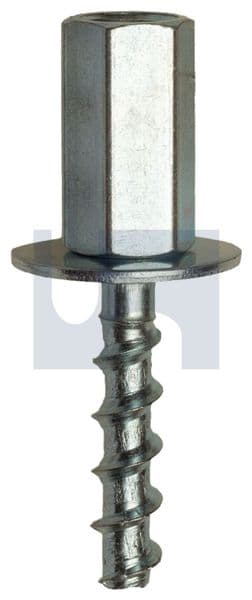
Mungo MCS-I concrete screw hangers that screw into a concrete ceiling and take M8 or M10 threaded rod for hanging services.
About the MCS-I Concrete Screw Hanger
The Mungo MCS-I is a small concrete screw with a female thread in its head, screwed into a concrete ceiling or soffit to hang M8 or M10 threaded rod for pipes, ducts, cable tray and ceiling grids. It is a size 6 screw for a 6mm hammer drilled hole, zinc plated, in 35mm and 55mm lengths, packs of 50. Choose the length above; the guide below covers the European Technical Assessments, install values, edge distance and spacing.
Also called internal thread screw anchors, concrete screw hangers for allthread or screw-in rod anchors for concrete.
Features
- Concrete screw with internal M8 to M10 thread
- Zinc plated, RoHS compliant
- Self-tapping into pre-drilled concrete
- Non-expansion fixing
Applications
- Hanging threaded rod from concrete ceilings and soffits
- Pipes, ducts and cable tray
- Suspended ceiling grids
What an MCS-I concrete screw hanger is
The Mungo MCS concrete screw is screwed into a predrilled hole and its special thread cuts an internal thread into the concrete as it goes in, so it holds by mechanical interlock rather than expansion. The MCS-I is the version with an internal thread and a hexagon drive: instead of a head that clamps a fixture, it has a threaded body that takes threaded rod. Hobson gives the internal thread as M8 to M10, so it takes M8 or M10 threaded rod for suspending services.
Ours are size 6 (6mm nominal drill diameter, 7.5mm thread outside diameter per the ETA), zinc plated carbon steel, in two lengths. Hobson's descriptions give them as 6 x 35 and 6 x 55, which match the two nominal embedment depths, 35mm and 55mm, that ETA-16/0319 gives for size 6.
Which European Technical Assessment covers it
- ETA-16/0319 (Mungo concrete screw MCS, MCSr and MCShr, sizes 5 and 6) lists the MCS-I with internal thread and hexagon drive (example MCS-I 6x55 IM M8/10) as one of its anchor versions. It is assessed only for multiple use for non-structural applications (ETAG 001 Part 6), for anchorages in prestressed hollow core slabs, and for anchorages with fire resistance requirements (not in hollow core slabs). Hobson's declaration of performance for sizes 5 and 6 refers to it.
- Multiple use for non-structural applications means the service hangs from several anchors acting together, so if one anchor slips or fails, its load passes to the neighbouring anchors (Hobson's article on options in ETAG certifications). The ETA does not cover a service hung from a single MCS-I; the designer sets the number of fixing points.
- ETA-16/0296 (Option 1, sizes 6 to 14) also shows the MCS-I configuration among its screw types, at size 6 embedments of 40 and 55mm. Its values for size 6 differ from ETA-16/0319, so an anchor design works to one ETA in full, not a mix of the two.
- Both ETAs cover reinforced or unreinforced normal weight concrete of strength class C20/25 to C50/60, cracked and uncracked, and say anchorages are designed under the responsibility of an engineer experienced in anchorages and concrete work, with installation by appropriately qualified people under the supervision of the person responsible for technical matters on site.
- Drilling: for size 6, both ETAs allow hammer drilled holes only (ETA-16/0296 also allows hollow drilling, but only for sizes 8 to 14).
- Zinc plated MCS screws may only be used in dry internal conditions under the ETA.
MCS-I sizes and installation values
Both hangers are size 6 with an M8 to M10 internal thread; the length sets the embedment and everything that follows from it. Select a row to open that hanger in the selector.
Every MCS-I we carry, shortest first. Values in mm (torques in Nm) from ETA-16/0319 Tables B1 and B2, size 6: drill = nominal drill bit diameter (cutting diameter of the bit at most 6.40), hole depth = minimum depth of drill hole, max install torque = Tinst, max impact driver torque = maximum nominal torque for installation with an impact screwdriver. For the 55mm embedment, ETA-16/0296 gives a minimum member thickness of 80mm; we show the larger ETA-16/0319 value. Packs of 50. Tap a number to show it in the selector above.
| Hanger | Code | Embedment | Drill | Hole depth | Max install torque | Max impact driver torque | Min member thickness | Min edge distance | Min spacing | Pack |
|---|---|---|---|---|---|---|---|---|---|---|
| 6 x 35, M8/M10 | MUMMCSI05540603 | 35 | 6 | 40 | 10 | 150 | 80 | 35 | 35 | 50 |
| 6 x 55, M8/M10 | MUMMCSI05540605 | 55 | 6 | 60 | 10 | 150 | 100 | 40 | 40 | 50 |
Edge distance, spacing and member thickness
The minimums in the table are the closest an MCS-I may go to an edge or to another anchor, and the thinnest concrete it may go into. They are not distances at which it keeps its full capacity. ETA-16/0319 also gives the distances below which the concrete capacity starts to reduce: for concrete cone failure, an edge distance of 1.5 times and a spacing of 3 times the effective anchorage depth (27mm for the 35mm embedment, 44mm for the 55mm), and for splitting, an edge distance of 60mm and spacing of 120mm (35mm embedment) or 80mm and 160mm (55mm embedment). Closer than those, the engineer's design reduces the load per anchor.
In prestressed hollow core slabs (C30/37 to C50/60, size 6 only), ETA-16/0319 sets a minimum edge distance, anchor spacing and distance between anchor groups of 100mm each, keeps each anchor at least 50mm from the prestressing steel, and only covers slabs with a core distance of at least 100mm, a prestressing steel spacing of at least 100mm and a core width no more than 4.2 times the web thickness. It ties the characteristic resistance to the bottom flange thickness (1kN at 25mm or more, 2kN at 30mm, 3kN at 35mm, installation safety factor 1.2): these are characteristic values for the engineer's design, not safe loads. Its fire values do not apply in hollow core slabs.
Loads: why we do not quote a working load
The ETAs give characteristic values for an engineer's design (design method A), not working loads, and the two ETAs give different concrete pull-out values for size 6 at 55mm embedment. A characteristic value is not a safe load: it has partial safety factors applied in the design, and edge distance, spacing, member thickness, cracked or uncracked concrete and concrete strength all change it. So we do not publish a single load for these hangers, and the load per hanger, the spacing and the layout are for the services designer or engineer working to the complete ETA. The ETA covers multiple use only: the service hangs from several anchors so that if one slips or fails its load passes to its neighbours, not from a single MCS-I.
For fire design, ETA-16/0319 declares reaction to fire class A1 and gives characteristic steel resistances for fire resistance classes R30 to R120, with concrete failure modes calculated to EOTA TR 020 or CEN/TS 1992-4. Ask us and we will send the ETA and Hobson's declarations of performance for your engineer.
Zinc plated: dry internal conditions only
These are zinc plated. Hobson's finish comparison puts zinc plating at about 5 microns with low corrosion resistance, recommended for indoor and non-corrosive environments, and the ETA allows the zinc plated MCS only in dry internal conditions. ETA-16/0319 reserves external atmospheric exposure and permanently damp internal conditions for its A4 and HCR stainless screws, which are not in this range. For a carpark soffit open to the weather, a coastal site or anywhere damp, ask us for a fixing suited to that exposure.
How to install an MCS-I concrete screw hanger
- Mark the positions from the services design, keeping to the minimum edge distance, spacing and member thickness in the table.
- Hammer drill a 6mm hole to at least 40mm deep (35mm embedment) or 60mm deep (55mm embedment). Hammer drilling only.
- Clean the dust out of the hole with a hand pump or blower.
- Drive the MCS-I in with an impact screwdriver (maximum nominal impact torque 150Nm) or set it with a torque wrench to no more than 10Nm, until it reaches its full embedment and seats against the concrete. Ask us for the socket that suits the hexagon drive.
- Check it: once set, it must not be possible to turn it any further, and the head must be undamaged (ETA). If it keeps turning, it has not gripped the concrete; do not hang anything from it.
- Screw the M8 or M10 threaded rod into the internal thread and hang the service.
Concrete screw hangers in Adelaide
Allmat supplies MCS-I concrete screw hangers, XBolt PRO hangers, threaded rod and hole cleaning gear to electricians, plumbers, fire services and HVAC installers and builders across Adelaide and South Australia. Add the hangers to a quote with the rod and we will price the lot.
Concrete screw hangers with your allthread
MCS-I concrete screw hangers, XBolt PRO hangers, threaded rod and hole cleaning gear are available to order from Allmat for electricians, plumbers, fire services and HVAC installers, builders and trade across Adelaide and South Australia. Order through Allmat, we pick and pack it, then click and collect from the Allmat yard or have it delivered to site.
Goes with
Questions
What drill size for an MCS-I concrete screw hanger?
6mm, hammer drilled, to at least 40mm deep for the 35mm hanger and 60mm deep for the 55mm hanger (ETA-16/0319). Clean the dust out before driving it in.
What rod fits an MCS-I?
Hobson lists the internal thread as M8 to M10, so it takes M8 or M10 threaded rod.
How close to an edge can it go?
Under ETA-16/0319 the minimum edge distance and spacing are 35mm for the 35mm embedment and 40mm for the 55mm embedment, in concrete at least 80mm and 100mm thick respectively. Those are minimums only: closer than 1.5 times the effective anchorage depth to an edge (or the splitting edge distance of 60 or 80mm), the engineer's design reduces the load.
How much load will an MCS-I hold?
The ETAs give characteristic values for an engineer's design, not working loads, and they depend on the embedment, edge distance, spacing, member thickness and the concrete. The two ETAs also give different pull-out values at 55mm. So we do not quote a single load: the services designer or engineer sets the load per hanger and the spacing from the complete ETA. The ETA covers multiple use for non-structural applications only: the service hangs from several anchors, so if one slips or fails its load passes to its neighbours (Hobson's ETAG options article). It does not cover a service hung from a single MCS-I.
Can MCS-I hangers go into hollow core slabs?
ETA-16/0319 covers size 6 in prestressed hollow core slabs of C30/37 to C50/60, with at least 100mm edge distance, spacing and distance between groups, at least 50mm from the prestressing steel, a core distance and prestressing steel spacing of at least 100mm, and a core width no more than 4.2 times the web thickness. The characteristic resistance (1 to 3kN, set by a bottom flange of 25mm or more) is for the engineer's design, not a safe load. Its fire values do not apply in hollow core slabs, and the design is by an engineer.
Can I use them outside?
No. They are zinc plated, and the ETA allows zinc plated MCS screws only in dry internal conditions. Ask us for a fixing suited to damp or exposed positions.
Where can I buy concrete screw hangers in Adelaide?
Order through Allmat. Order ahead by phone on 1300 03 03 63 or send your list for a quote, then click and collect from 25 Kapara Road, Gillman, or have them delivered to site.
MCS-I Concrete Screw Hanger: sizes and finishes we supply
2 lines by finish. Pick one above for its product code and pack sizes.
| Finish | Sizes | Lengths | Lines |
|---|---|---|---|
| Zinc Plated | 6 | 35 / M8 - M10, 55 / M8 - M10 | 2 |
Data sheets and documents
The documents for the product you choose are listed with the selector above. Here is every MCS-I Concrete Screw Hanger document from Hobson Engineering.
All MCS-I Concrete Screw Hanger documents (10)
Data sheets and technical data (4)
Approvals (ETA, DoP) (4)
Need them in bulk?
Add the sizes you need to your quote, or send us your list and we’ll price the lot and supply it with the rest of your order.
Browse all anchors & fixings