
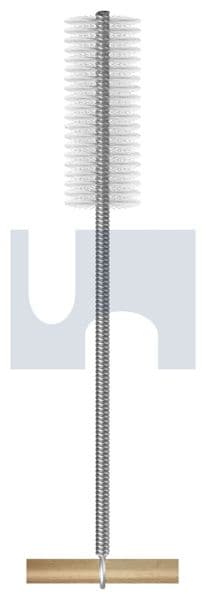
Anchor Hole Cleaning
Brushes and blow-out pumps for cleaning drilled holes before setting chemical and mechanical anchors.
About the Anchor Hole Cleaning
Anchor holes must be blown and brushed clean before you set a chemical or mechanical anchor, or the anchor will not hold as rated; these are the brushes and pumps for the job. They come as Mungo power tool steel brushes (10 / 12 to 55 / 58), HEC steel power brushes (10 to 24), Mungo steel and nylon hand brushes, HEC nylon hand brushes, SDS-plus adaptors and 300mm extensions, an 840ml blow-out pump and the Mungo MIT-AP-D1 compressed air tool. Choose the brush or tool above; the guide below covers Hobson's blow, brush, blow method and which brush suits which hole.
Also called hole cleaning brushes, blow out pumps or chemical anchor brushes.
Features
- Nylon bristle hand brushes with wooden handle, 8, 10 and 22mm x 300mm
- Steel power tool brushes, 10 to 24mm (HEC) and Mungo MIT-BS-M1 from 10/12 to 55/58
- Mungo steel and nylon hand brushes, 300mm long
- SDS-plus brush adaptors (M6) and 300mm brush extensions
- 840ml blow-out pump and Mungo MIT-AP-D1 compressed air blow-out tool
Applications
- Cleaning drilled holes before chemical anchoring
- Blowing dust out of anchor holes
Why anchor holes need cleaning
Drilling a hole in concrete or masonry leaves dust packed against its walls and in the bottom. A chemical anchor holds by the resin bonding to the wall of the hole, so dust left behind sits between the resin and the concrete. Hobson's article on concrete anchoring lists chemical anchors as sensitive to poor hole cleaning; spin-in capsules are less sensitive because the resin mixes with the remaining dust.
Hobson's chemical stud and internal thread anchor data sheets say to clean the hole following the chemical maker's instructions and, as a minimum, to follow the AEFAC (Australian Engineered Fasteners and Anchors Council) certified installer method. Each XCHEM PRO resin data sheet shows its own cleaning sequence, and a chemical anchor only reaches the values in its ETA or data sheet when it is installed that way. Hobson's steps for mechanical anchors, such as drop-in anchors, also start with blowing the dust out of the hole.
Blow, brush, blow: the hole cleaning method
The AEFAC certified installer method, as set out on Hobson's chemical stud and internal thread anchor data sheets, is the minimum for those anchors. The XCHEM PRO resin sheets show their own steps, with compressed air and a drill-driven brush, and refer you to the ETA for full installation (see the table below). The stud sheet minimum is:
- Blow the hole out from the bottom, 3 times, with a hand pump (holes up to 20mm diameter) or compressed air at 6 bar or more.
- Brush the hole from the bottom, 3 times, with the correct wire brush (brush diameter at least the hole diameter), turning the brush as you pull it out.
- Blow the hole out from the bottom again, 3 times, with the hand pump or compressed air.
- Then inject the resin and set the stud or rod as the resin maker's instructions say.
Cleaning counts from Hobson documents. Where the resin you use asks for more than the AEFAC minimum, follow the resin's data sheet and ETA.
| Product | Cleaning sequence | Source |
|---|---|---|
| Hobson chemical stud anchors and internal thread anchors (AEFAC minimum) | Blow 3 times, brush 3 times, blow 3 times | Data sheets 260605DS and 221209 |
| XCHEM PRO H501 hybrid, V401 vinylester and P201 polyester, in concrete | Blow 4 times with compressed air, brush 4 times with a drill-driven brush, blow 4 times | Installation steps on each XCHEM PRO data sheet; full installation per its ETA |
| XCHEM PRO E701 epoxy, in concrete | Blow 2 times, brush 2 times, blow 2 times, brush 2 times, blow 2 times, with compressed air and a drill-driven brush | Installation steps on the E701 data sheet; full installation per its ETA |
Which brush for which hole and anchor
Mungo labels its brushes with two numbers: the hole diameter, then the brush diameter. Mungo's MIT-SP data sheet pairs a 10mm hole with a 12mm brush (article 1690040, our 10 / 12) and a 16mm sleeve hole with an 18mm brush (1690043, our 16 / 18). The MIT-BS-H1 and MIT-BN-H1 hand brushes give a range of holes before the slash, for example 14-18 / 20 for 14 to 18mm holes with a 20mm brush.
The brush diameter for each anchor is on its data sheet. The table below takes it from Hobson's chemical stud anchor sheet (260605DS, which also covers the long rod kits), the internal thread anchor sheets and the Mungo MIT-SP sheet, and matches it to the Mungo brushes with that brush diameter. For the M20 internal thread anchor (34mm hole) the sheet gives a 36mm brush; the nearest in the range is 35 / 37, so check with us.
The HEC steel power brushes (10 to 24) and nylon hand brushes (8, 10 and 22) are labelled with one number. Hobson publishes no data sheet saying whether it is the hole or the brush diameter, so check the brush against the brush size on your anchor's or resin's data sheet; the brush must be at least as wide as the hole. The anchor sheets call for a wire brush, so treat the nylon brushes as the exception (see steel or nylon below).
For the M12 internal thread anchor (22mm hole) the sheet asks for a 26mm brush, so the table points to the Mungo 24 / 26 brush even though Mungo labels it for a 24mm hole.
Hole and brush diameters from Hobson's chemical stud anchor (260605DS), internal thread anchor (211201, 221209) and Mungo MIT-SP data sheets. Chemical stud and internal thread anchor rows are for concrete. MIT-SP rows are for aerated concrete and solid masonry (rod without sleeve) or solid and hollow masonry (with sleeve), as the MIT-SP sheet sets out. Select a row to open the Mungo power brush with that brush diameter. Tap a number to show it in the selector above.
| Drill hole | Used for | Brush Ø on the sheet | Mungo power brush (MIT-BS-M1) | Mungo hand brush (MIT-BS-H0) |
|---|---|---|---|---|
| 10mm | M8 chemical stud in concrete (Hobson 260605DS); M8 rod in MIT-SP without sleeve (aerated concrete and solid masonry) | 12mm | 10 / 12 | 10 / 12 |
| 12mm | M10 chemical stud in concrete; M10 rod in MIT-SP without sleeve (aerated concrete and solid masonry); MIT-SP SH 12 x 80 sleeve (solid and hollow masonry) | 14mm | 12 / 14 | 12 / 14 |
| 14mm | M12 chemical stud and M8 internal thread anchor in concrete; M12 rod in MIT-SP without sleeve (aerated concrete and solid masonry) | 16mm | 14 / 16 | 14 / 16 |
| 16mm | MIT-SP SH 16 sleeves (solid and hollow masonry) | 18mm | 16 / 18 | No exact match in the range |
| 18mm | M16 chemical stud and M10 internal thread anchor in concrete; M16 rod in MIT-SP without sleeve (aerated concrete and solid masonry) | 20mm | 18 / 20 | 18 / 20 |
| 20mm | MIT-SP SH 20 sleeves (solid and hollow masonry) | 22mm | 20 / 22 | No exact match in the range |
| 22mm | M12 internal thread anchor (Mungo labels the 24 / 26 brush for a 24mm hole; the sheet asks for a 26mm brush) | 26mm | 24 / 26 | 24 / 26 |
| 24mm | M20 chemical stud | 26mm | 24 / 26 | 24 / 26 |
| 28mm | M24 chemical stud; M16 internal thread anchor | 30mm | 28 / 30 | 28 / 30 |
Hole cleaning brushes and tools we carry
Every brush, adaptor, extension and blow-out tool on this page. Mungo brush sizes are hole / brush diameter; HEC sizes are as Hobson labels them.
Sizes and lengths in mm as Hobson lists them. "Not listed" = Hobson gives no length for that item. Pack is the minimum order. Tap a number to show it in the selector above.
Hand pump or compressed air?
Hobson's chemical stud and internal thread anchor sheets allow a hand pump for holes up to 20mm diameter as the AEFAC minimum. For larger holes they call for compressed air at a minimum of 6 bar. The XCHEM PRO resin sheets show compressed air (an air blow gun), so where you use one of those resins follow its sheet and ETA. Always blow from the bottom of the hole so the dust comes out rather than being pushed around.
The HEC blow-out pump holds 840ml. The Mungo MIT-AP-D1 is a metal compressed air blow-out tool with a 1/4 inch internal thread for the air line fitting, for holes too big for a hand pump or for a lot of holes.
Power brushes, SDS-plus adaptors and extensions
Power brushes fit a drill through an SDS-plus brush adaptor, and a 300mm brush extension adds reach when the hole is deeper than the brush. Hobson lists both the HEC and the Mungo adaptors and extensions in size M6; use the adaptor and extension of the same brand as the brushes. On the stud sheets' AEFAC minimum, a hand or power brush both work the same way: from the bottom of the hole, 3 passes, with a brush at least as wide as the hole. The XCHEM PRO resin sheets show the brush driven by a drill, so with those resins use a power brush and follow the sheet and its ETA.
Steel or nylon brush?
Hobson's chemical stud and internal thread anchor sheets call for a wire brush, and the Mungo MIT-SP sheet lists steel brushes for its installation data. Use a steel brush unless the resin or anchor maker's instructions name a nylon one. Mungo also makes a nylon hand brush (MIT-BN-H1, 10-16 / 20) and a steel and nylon RB-H brush in 28, and HEC makes nylon hand brushes with a wooden handle.
Anchor hole cleaning gear in Adelaide
Allmat supplies hole cleaning brushes, blow-out pumps, chemical anchor resin, studs, guns and nozzles to builders, concreters and steel fixers across Adelaide and South Australia. Add the brushes to a quote with the resin and studs, and we will price the lot.
Hole cleaning gear with your chemical anchors
Hole cleaning brushes, SDS-plus brush adaptors, extensions, blow-out pumps and compressed air blow-out tools are available to order from Allmat with the resin, studs and guns, for builders, concreters, steel fixers and trade across Adelaide and South Australia. Order through Allmat, we pick and pack it, then click and collect from the Allmat yard or have it delivered to site.
Goes with
Questions
How do you clean a hole for a chemical anchor?
Blow, brush, blow, from the bottom of the hole. As a minimum, Hobson's data sheets call for the AEFAC method: blow out 3 times, brush 3 times with a wire brush at least as wide as the hole, blow out 3 times. XCHEM PRO H501, V401 and P201 ask for 4 times each; E701 asks for blow 2, brush 2, blow 2, brush 2, blow 2.
What size brush for an M12 chemical anchor stud?
Hobson's chemical stud sheet gives a 14mm drill hole and a 16mm brush for M12, so a Mungo 14 / 16 brush, either the hand brush or the power tool brush.
What do the two numbers on a Mungo hole cleaning brush mean?
Hole diameter, then brush diameter. A 14 / 16 brush is a 16mm brush for a 14mm hole. Range brushes such as 14-18 / 20 suit holes from 14 to 18mm with a 20mm brush.
Is a hand blow-out pump enough?
Hobson's chemical stud anchor sheets allow a hand pump for holes up to 20mm as the AEFAC minimum; bigger holes need compressed air at 6 bar or more, for example through the Mungo MIT-AP-D1 blow-out tool. The XCHEM PRO resin sheets show compressed air and a drill-driven brush, so where you use one of those resins follow its sheet and ETA.
Should I use a steel or nylon brush?
Hobson's chemical anchor sheets call for a wire (steel) brush. Use nylon only where the resin or anchor maker's instructions name a nylon brush.
Can I put a hole cleaning brush in a drill?
Yes, the power tool brushes fit a drill with an SDS-plus brush adaptor of the same brand, and a 300mm extension reaches deeper holes. The XCHEM PRO resin sheets show a drill-driven brush. Keep to the number of passes the resin asks for.
Where can I buy anchor hole cleaning brushes in Adelaide?
Order through Allmat. Order ahead by phone on 1300 03 03 63 or send your list for a quote, then click and collect from 25 Kapara Road, Gillman, or have them delivered to site.
Anchor Hole Cleaning: sizes and finishes we supply
41 lines by type and finish. Pick one above for its product code and pack sizes.
| Type | Variant | Sizes | Lengths | Lines |
|---|---|---|---|---|
| Steel brush, power tool | Steel Brush-power Tool | 10 / 12, 12 / 14, 14 / 16, 16 / 18, 18 / 20, 20 / 22, 24 / 26, 28 / 30, 32 / 34, 35 / 37, 40 / 41.5, 45 / 47, 52 / 54, 55 / 58 | 170, 200, 250, 300 | 14 |
| Hand brush | Universal Steel Hand Brush | 8 / 10, 10 / 12, 12 / 14, 14 / 16, 18 / 20, 24 / 26, 28 / 30 | 300 | 7 |
| Brush for power tool | Steel Bristles | 10, 12, 18, 20, 22, 24 | 170, 200, 250 | 6 |
| Brush with handle | Nylon Bristles Wooden Handle | 8, 10, 22 | 300 | 3 |
| Steel brush, hand | Steel Brush | 10-12 / 14, 14-18 / 20, 22-26 / 29 | 300 | 3 |
| Brush SDS-PLUS adapt | Steel | M6 | - | 1 |
| Brush extension tool | Steel | M6 | 300 | 1 |
| Blow out pump | Purging Pump | 840ml | - | 1 |
| Steel and nylon hand brush | Steel/nylon Hand Brush | 28 | - | 1 |
| Nylon brush, hand | Nylon Hand Brush | 10-16 / 20 | 300 | 1 |
| SDS-plus brush adapter | Steel | M6 | - | 1 |
| Brush extension | Brush Extension | M6 | 300 | 1 |
| Compressed air blow-out tool | Compressed Air Tool Metal | - | - | 1 |
Data sheets and documents
The documents for the product you choose are listed with the selector above. Here is every Anchor Hole Cleaning document from Hobson Engineering.
All Anchor Hole Cleaning documents (5)
Data sheets and technical data (2)
Guides and articles (3)
Need them in bulk?
Add the sizes you need to your quote, or send us your list and we’ll price the lot and supply it with the rest of your order.
Browse all anchors & fixings