
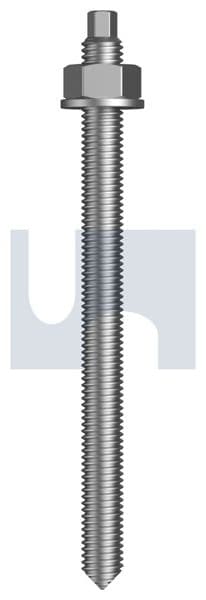
Chemical Anchor Kit
Chemical anchor stud kits with external hex drive, for setting into resin in concrete and masonry: hot dip galvanised, class 5.8 and 8.8, M8 to M24.
About the Chemical Anchor Kit
Chemical anchor rod kits are galvanised threaded studs set in resin to hold down posts, steel base plates, plant and handrails in concrete and masonry; each kit has a stud with a hex drive end and chisel point, a nut and a washer. They come in class 5.8 or class 8.8, from M8 x 110mm to M24 x 300mm, with long kits to 300mm in M12, 500mm in M16 and 480mm in M20 for deep embedment or thick fixtures, and with no embedment notch, which Hobson says gives flexible drilling depth. Choose the class, size and length above; the guide below covers length, drill size, embedment and setting. Resin is sold separately.
Also called chemical anchor rod kits, chemset kits or anchor rod and resin kits.
Features
- Class 5.8 and class 8.8 versions
- Hot dip galvanised finish
- External hex drive and chisel point
- M8 x 110 through to M24 x 300, with M16 up to 500mm long
Applications
- Resin-set threaded studs in concrete and masonry
- Holding down steel base plates, posts and plant
Chemical anchor rod kits
A chemical anchor rod is a threaded stud set in a drilled hole with resin instead of expansion. Hobson describes its chemical stud anchors as non-expansion fasteners made up of a stud, nut and washer, set in a pre-drilled hole with a curing resin from a glass capsule or an injection system. Its sheets for these kits list fixing to concrete or masonry, jobs that need a non-expansion fastener, and jobs that need closer edge distance and spacing.
Common jobs include holding down steel base plates, posts and plant. Hobson publishes no holding capacity for these kits: what a resin anchor holds depends on the resin, the embedment, the base material, and the edge distance and spacing, and comes from the resin's ETA or data sheet. For any structural or safety-critical fixing, the rod, resin, embedment and layout come from the engineer's or designer's specification.
What is in a chemical anchor kit
- Stud: hot dip galvanised (AS 1214), class 5.8 or class 8.8 (AS 4291.1), with an external hex drive on top and a chisel point. Hobson's sheet gives a minimum stud tensile strength of 520MPa for class 5.8 and 800MPa for class 8.8 (830MPa for M20 and M24).
- Nut and washer: a class 5 nut (DIN 934) and HV 100 washer (DIN 125) with the class 5.8 kits; a class 8 nut and HV 200 washer with the class 8.8 kits.
- A 1/4 inch hex drive comes in each pack of external hex drive stud anchors, so the stud can be spun into a glass capsule with a hammer drill.
- No embedment notch: the studs on our chemical anchor bolts page carry an embedment mark; these rods do not, which Hobson says gives flexible drilling depth and fixture thickness.
- Resin is not included: it is on the chemical anchor resin page, with guns and nozzles on the accessories page.
Which length of chemical anchor rod?
Each kit is a fixed length, so the length is shared between the embedment in the concrete and the thickness of the fixture you clamp. Hobson's tables give a maximum fixture thickness for each kit. They do not say what embedment it assumes, but the figures work out at the recommended embedment: length minus embedment minus fixture is the same for every length of one size (M12: 160 minus 110 minus 24 = 26, and 220 minus 110 minus 84 = 26), which leaves room for the nut, washer and thread past it. Because the rod length is fixed, every extra millimetre of embedment takes a millimetre off that fixture thickness.
Hobson lists the long kits for jobs where deeper embedment is needed. For example, an M16 x 300mm kit clamps up to 145mm at the recommended 125mm embedment, or up to 95mm if the design calls for 175mm embedment. The embedment comes from the design or the resin's data, not from the rod length.
Chemical anchor rod sizes
Drill and recommended embedment from the installation parameters in Hobson's chemical stud anchor data sheet (260605DS); max fixture thickness and hex drive across flats from its no-notch external hex drive tables (the tables do not state the embedment behind the max fixture figures; they work out at the recommended embedment, as length minus embedment minus fixture is constant for each size). Where the sheet gives two maximum fixture figures for one size, we show the lower. Pack is the minimum order. Tap a number to show it in the selector above.
| Range | Size | Drill | Recommended embedment | Max fixture thickness | Hex drive | Pack |
|---|---|---|---|---|---|---|
| Class 5.8, hot dip galvanised | ||||||
| Class 5.8, hot dip galvanised | M8 x 110mm | 10mm | 80mm | 10mm | 5mm | Packs of 10 |
| Class 5.8, hot dip galvanised | M10 x 130mm | 12mm | 90mm | 18mm | 7mm | Packs of 10 |
| Class 5.8, hot dip galvanised | M12 x 160mm | 14mm | 110mm | 24mm | 8mm | Packs of 10 |
| Class 5.8, hot dip galvanised | M12 x 220mm | 14mm | 110mm | 84mm | 8mm | Packs of 10 |
| Class 5.8, hot dip galvanised | M12 x 300mm | 14mm | 110mm | 164mm | 8mm | Packs of 10 |
| Class 5.8, hot dip galvanised | M16 x 190mm | 18mm | 125mm | 35mm | 12mm | Packs of 10 |
| Class 5.8, hot dip galvanised | M16 x 220mm | 18mm | 125mm | 65mm | 12mm | Packs of 10 |
| Class 5.8, hot dip galvanised | M16 x 260mm | 18mm | 125mm | 105mm | 12mm | Packs of 10 |
| Class 5.8, hot dip galvanised | M16 x 300mm | 18mm | 125mm | 145mm | 12mm | Packs of 10 |
| Class 5.8, hot dip galvanised | M16 x 350mm | 18mm | 125mm | 195mm | 12mm | Packs of 10 |
| Class 5.8, hot dip galvanised | M16 x 500mm | 18mm | 125mm | 345mm | 12mm | Packs of 10 |
| Class 5.8, hot dip galvanised | M20 x 260mm | 24mm | 170mm | 50mm | 12mm | Packs of 10 |
| Class 5.8, hot dip galvanised | M20 x 350mm | 24mm | 170mm | 140mm | 12mm | Packs of 10 |
| Class 5.8, hot dip galvanised | M20 x 400mm | 24mm | 170mm | 190mm | 12mm | Packs of 10 |
| Class 5.8, hot dip galvanised | M20 x 480mm | 24mm | 170mm | 270mm | 12mm | Packs of 10 |
| Class 5.8, hot dip galvanised | M24 x 300mm | 28mm | 210mm | 56mm | 13mm | Packs of 5 |
| Class 8.8, hot dip galvanised | ||||||
| Class 8.8, hot dip galvanised | M8 x 110mm | 10mm | 80mm | 10mm | 5mm | Packs of 10 |
| Class 8.8, hot dip galvanised | M10 x 130mm | 12mm | 90mm | 18mm | 7mm | Packs of 10 |
| Class 8.8, hot dip galvanised | M12 x 160mm | 14mm | 110mm | 24mm | 8mm | Packs of 10 |
| Class 8.8, hot dip galvanised | M12 x 220mm | 14mm | 110mm | 84mm | 8mm | Packs of 10 |
| Class 8.8, hot dip galvanised | M12 x 300mm | 14mm | 110mm | 164mm | 8mm | Packs of 10 |
| Class 8.8, hot dip galvanised | M16 x 190mm | 18mm | 125mm | 35mm | 12mm | Packs of 10 |
| Class 8.8, hot dip galvanised | M16 x 220mm | 18mm | 125mm | 65mm | 12mm | Packs of 10 |
| Class 8.8, hot dip galvanised | M16 x 260mm | 18mm | 125mm | 105mm | 12mm | Packs of 10 |
| Class 8.8, hot dip galvanised | M16 x 300mm | 18mm | 125mm | 145mm | 12mm | Packs of 10 |
| Class 8.8, hot dip galvanised | M16 x 350mm | 18mm | 125mm | 195mm | 12mm | Packs of 10 |
| Class 8.8, hot dip galvanised | M16 x 500mm | 18mm | 125mm | 345mm | 12mm | Packs of 10 |
| Class 8.8, hot dip galvanised | M20 x 260mm | 24mm | 170mm | 50mm | 12mm | Packs of 10 |
| Class 8.8, hot dip galvanised | M20 x 350mm | 24mm | 170mm | 140mm | 12mm | Packs of 10 |
| Class 8.8, hot dip galvanised | M20 x 400mm | 24mm | 170mm | 190mm | 12mm | Packs of 10 |
| Class 8.8, hot dip galvanised | M20 x 480mm | 24mm | 170mm | 270mm | 12mm | Packs of 10 |
| Class 8.8, hot dip galvanised | M24 x 300mm | 28mm | 210mm | 56mm | 13mm | Packs of 5 |
Embedment, edge distance, spacing and base material thickness
From the installation parameters on Hobson's chemical stud anchor data sheet, which covers these no-notch kits. Hobson gives the minimum base material depth as the embedment plus 30mm (and at least 100mm) for M8 to M12, and the embedment plus twice the drill size for M16 to M24; the figures below are that arithmetic at the recommended embedment. If you set a rod deeper, the formula is written in terms of the embedment, so work it from your depth and check it against the resin's data. For example, an M16 rod set 175mm deep in an 18mm hole needs at least 175 + 2 x 18 = 211mm of base material.
Hobson's sheet gives one value for minimum spacing and minimum edge distance. These are minimums for installing the rod, not load figures: what the fixing can carry, and how much that drops close to an edge, another anchor or the back of a thin slab, comes from the resin's ETA or data sheet and the design.
Dimensions in mm, Hobson chemical stud anchor data sheet (260605DS), installation parameters. Each row opens the class 5.8 kit at the standard length for that size; the values apply to every kit of that size. Tap a number to show it in the selector above.
How to set a chemical anchor rod
From the installation guide on Hobson's chemical stud anchor data sheet. Follow the resin maker's instructions as well. Hobson's Clean Holes article reports that holes not cleaned before the resin goes in can lose as much as 60% of their pull-out strength.
- Drill the hole at the drill size and to the embedment depth for the rod (see the tables). Do not use a diamond drill bit where the resin maker says not to.
- Clean the hole. As a minimum, Hobson calls for the AEFAC certified installer method: from the bottom of the hole, blow it out 3 times with a hand pump (holes up to 20mm) or compressed air at 6 bar or more; brush it 3 times with the right wire brush (at least the hole diameter), rotating as you pull out; then blow it out 3 times again.
- Prepare the resin (polyester, vinylester, epoxy) as its maker directs.
- Insert the rod, rotating it slowly to spread the resin. With a glass capsule, the hex drive rod can be driven in with a hammer drill and the hex drive bit from the pack.
- The rod should sit at the bottom of the hole with resin showing at the top. Clean off the excess.
- Do not disturb the rod while the resin cures, and do not load it until the resin maker's cure time has passed. Then fit the fixture, washer and nut, and tighten.
Galvanised, class 5.8 or 8.8: which to use where
- Hot dip galvanised: Hobson rates it high corrosion resistance (50 micron) and recommends it for long term outdoor use. Hobson's corrosion guide for metal connectors lists hot dip galvanising or stainless for work exposed to the weather outside the sea spray zone.
- Sea spray zone and within 2m of a pool edge: the corrosion guide calls for stainless (316 near a pool). These rod kits are galvanised only; 316 stainless studs, in the standard lengths from M8 x 110 to M24 x 300mm, are on the chemical anchor bolts page.
- Class 8.8 is the higher strength stud (800 to 830MPa minimum tensile against 520MPa for class 5.8). Which class a fixing needs comes from the design.
Chemical anchor rods in Adelaide
Allmat supplies chemical anchor rod kits, studs, resin, injection guns and hole cleaning gear to builders, steel fixers, fabricators and trade across Adelaide and South Australia. Add the kits to a quote with the resin, nozzles and brushes, and we will price the lot.
Chemical anchor rod kits, resin and gear
Chemical anchor rod kits, resin, injection guns, nozzles and hole cleaning gear are available to order from Allmat for builders, steel fixers, fabricators, plumbers and trade across Adelaide and South Australia. Order through Allmat, we pick and pack it, then click and collect from the Allmat yard or have it delivered to site.
Goes with
Questions
What is in a chemical anchor kit?
A hot dip galvanised threaded stud with an external hex drive and chisel point, a nut and a washer. A 1/4 inch hex drive comes in each pack. The resin is sold separately.
What size hole for a chemical anchor rod?
From Hobson's sheet: 10mm for M8, 12mm for M10, 14mm for M12, 18mm for M16, 24mm for M20 and 28mm for M24, with recommended embedments of 80, 90, 110, 125, 170 and 210mm.
Why buy a longer chemical anchor rod?
For deeper embedment or a thicker fixture. Hobson's tables give a maximum fixture of 24mm for the M12 x 160mm rod, 84mm for the M12 x 220mm and 164mm for the M12 x 300mm, which works out at the recommended 110mm embedment. Every extra millimetre of embedment takes a millimetre off those figures.
How close to an edge can a chemical anchor rod go?
Hobson's sheet gives a minimum edge distance and spacing of 40mm (M8), 50mm (M10), 60mm (M12), 80mm (M16), 100mm (M20) and 120mm (M24). Those are installation minimums: the load the fixing can carry near an edge or another anchor comes from the resin's ETA or data sheet and the design.
How thick does the concrete need to be?
At the recommended embedment, Hobson's formula gives a minimum base material depth of 110mm (M8), 120mm (M10), 140mm (M12), 161mm (M16), 218mm (M20) and 266mm (M24). A deeper embedment needs a thicker base.
Does the kit include the resin?
No. Chemical anchor resin (Chemset-style cartridges and capsules) is on its own page, with injection guns and nozzles on the accessories page.
How much load does a chemical anchor kit hold?
Hobson publishes no holding capacity for the kits. It depends on the resin, embedment, base material, edge distance and spacing: use the resin's ETA or data sheet, and an engineer's design for any structural or safety-critical fixing.
Where can I buy chemical anchor kits in Adelaide?
Order through Allmat. Order ahead by phone on 1300 03 03 63 or send your list for a quote, then click and collect from 25 Kapara Road, Gillman, or have them delivered to site.
Chemical Anchor Kit: sizes and finishes we supply
32 lines by type and finish. Pick one above for its product code and pack sizes.
| Type | Finish | Sizes | Lengths | Lines |
|---|---|---|---|---|
| Rod kit, external hex | Hot Dip Galvanised | M8, M10, M12, M16, M20, M24 | 110 to 500 (11 lengths) | 32 |
Data sheets and documents
The documents for the product you choose are listed with the selector above. Here is every Chemical Anchor Kit document from Hobson Engineering.
All Chemical Anchor Kit documents (8)
Data sheets and technical data (3)
Did You Know flyers (2)
Guides and articles (3)
Need them in bulk?
Add the sizes you need to your quote, or send us your list and we’ll price the lot and supply it with the rest of your order.
Browse all anchors & fixings