
A2-70 · A4-80 · Class 10 · Class 5 · Class 8 · Grade C
All-Metal Prevailing Torque Nut
All-metal lock nuts with no nylon insert that grip the bolt thread to stop the nut working loose under vibration.
About the All-Metal Prevailing Torque Nut
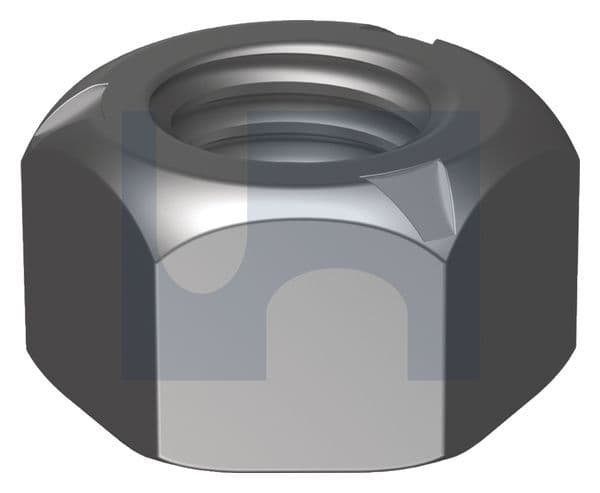
All-metal lock nuts grip the bolt thread with no nylon ring, to stop nuts working loose on machinery, mining and processing gear and other joints that vibrate. The range covers DIN 980 class 10 cone lock nuts (M6 to M48 coarse, M10 to M20 fine), grade C cone lock nuts in UNC and UNF from 1/4 to 2 inch, ESL dual slot nuts in class 8, 304 (A2-70) and 316 (A4-80), DIN 934K K-lock nuts with a captive tooth washer in M5 and M6, and BUMAX 88 collared lock nuts in M12, M16 and M20. Choose the type, size and finish above; the guide below covers tightening torques and reuse.
Also called cone lock nuts, prevailing torque nuts, Stover nuts or all-metal locknuts.
Features
- All-metal prevailing-torque lock
- No nylon insert
- DIN 980 class 10
- IFI 100-107 grade C
- Zinc plated
- Metric and imperial (UNC/UNF)
Applications
- Vibration-prone assemblies
- Mining and processing
Prevailing torque nuts: how they lock
Hobson defines a prevailing torque nut as a lock nut with a built-in element that creates friction on the mating thread and stops the nut turning freely. Nyloc, cone lock, met lock, stover and deformed thread nuts are all prevailing torque nuts. The ones on this page are all metal, with no nylon ring; for nylon insert lock nuts see the nyloc nut page.
- Cone lock nuts (DIN 980 class 10 and grade C): in Hobson's words, cone lock protects against loosening by adding prevailing torque to the connection.
- ESL dual slot self lock nuts (NFE 25 411): Hobson lists consistent prevailing torque, no galling, and locking slots that work independently of bolt tension, for mining and processing, railway and transport, energy, military and industrial work.
- K-lock nuts (DIN 934K): a nut and a free-spinning external tooth lock washer with 12 teeth, assembled as one piece. The washer resists loosening. Hobson lists electrical and electronic equipment, white goods, IT and communications equipment and robotics.
- BUMAX 88 collared lock nuts: Bumax's Lock data sheet says the root of the thread is cut at a larger angle to form a wedge-shaped surface, so once tightened the bolt thread bears metal to metal with no play. The nut locks in one direction, with the collar against the joint, and does not lock until it is tightened hard enough to meet resistance.
When does a joint need a prevailing torque nut?
Hobson's anti-vibration paper finds that a preload above about 65% of the fastener's yield load is enough to stop loosening at the vibration levels commonly seen in the field. Where a joint is subject to vibration and the bolt cannot be pretensioned to at least 65% of its proof load, the paper says a locking device must be used, and under severe vibration one may be needed anyway.
The same paper warns that two identical nuts locked against each other will hardly ever work, because both nuts rotate together under vibration.
Every all-metal lock nut we carry
Select a row to open that range in the selector, then pick the size.
All-metal lock nuts on this page, by range. Imperial sizes in inches. Metric fine sizes are thread x pitch (mm). Pack is the minimum order (BUMAX: minimum order 1). Tap a number to show it in the selector above.
| Type | Standard / class | Finish | Thread | Sizes | Pack |
|---|---|---|---|---|---|
| DIN 980 cone lock (HCL) | |||||
| DIN 980 cone lock (HCL) | Property class 10 | Zinc plated | Metric coarse | M6 to M48 | 2 to 200 |
| DIN 980 cone lock (HCL) | Property class 10 | Zinc plated | Metric fine | M10 x 1.25, M12 x 1.50, M14 x 1.50, M16 x 1.50, M20 x 1.50 | 50 to 200 |
| Grade C cone lock | |||||
| Grade C cone lock | Grade C | Zinc plated | UNC | 1/4" to 1-1/2", plus #12-24 metal lock nut | 25 to 100 |
| Grade C cone lock | Grade C | Zinc plated | UNF | 1/4" to 2" (1" in 12 and 14 TPI) | 5 to 100 |
| ESL dual slot self lock | |||||
| ESL dual slot self lock | NFE 25 411, class 8 | Zinc and top coat (see finishes) | Metric coarse | M6 to M27 | 25 to 100 |
| ESL dual slot self lock | NFE 25 411, A2-70 | 304 stainless | Metric coarse | M6 to M24 | 25 to 100 |
| ESL dual slot self lock | NFE 25 411, A4-80 | 316 stainless | Metric coarse | M8 to M24 | 25 to 100 |
| K-lock nut with tooth washer | |||||
| K-lock nut with tooth washer | DIN 934K, class 5 | Zinc plated | Metric coarse | M5, M6 | 1,000 |
| BUMAX 88 collared lock nut | |||||
| BUMAX 88 collared lock nut | BUMAX 88 (316L high Mo, A4) | Stainless | Metric coarse | M12, M16, M20 | Min. order 1 |
Cone lock nut tightening torque (DIN 980 class 10)
Hobson says standard torque values should not be used with prevailing torque nuts: the extra torque needed to turn the nut along the thread leaves a lower clamp load than expected. Add the prevailing torque to the target torque, T = F x k x d + Tpr, where F is the clamp load (kN), k the nut factor, d the thread diameter (mm) and Tpr the prevailing torque (Nm). The installation torques below already include it: for M12, 45.48 x 0.14 x 12 + 21 is about 97Nm. They use the maximum prevailing torque from ISO 2320, and Hobson notes this will likely give a higher clamp load than expected. Measuring the actual prevailing torque with a torque wrench as the nut runs down the thread, and adding that, gives a closer result.
Prevailing torque nuts must have full threads right through the locking element, and at least one full thread should show past the nut.
DIN 980 property class 10 cone lock nuts, metric coarse, zinc plated, from Hobson's tightening torque sheet (250225TD). Applies to our NC10ZCM codes only: not the fine thread, grade C, ESL, K-lock or BUMAX nuts, and the sheet does not cover our M42 and M48. A guide only, for the first tightening of single assemblies in isolation. Clamp load is 65% of proof stress for a class 10.9 bolt; nut factor k = 0.14 (zinc plated). Prevailing torques are the ISO 2320 maximums (50% of the DIN 267-15 values, per the sheet); Hobson notes using the maximum will likely give a higher clamp load than expected. Tap a number to show it in the selector above.
| Thread | Across flats (max, mm) | Height (max, mm) | Prevailing torque, first install (max, Nm) | Clamp load (kN) | Installation torque (Nm) |
|---|---|---|---|---|---|
| M6 | 10 | 6.0 | 4.0 | 10.84 | 13 |
| M8 | 13 | 8.0 | 8.0 | 19.75 | 30 |
| M10 | 17 | 10.0 | 14.0 | 31.29 | 58 |
| M12 | 19 | 12.0 | 21.0 | 45.48 | 97 |
| M14 | 22 | 14.0 | 31.0 | 62.04 | 153 |
| M16 | 24 | 16.0 | 42.0 | 84.70 | 232 |
| M18 | 27 | 18.5 | 56.0 | 103.58 | 317 |
| M20 | 30 | 20.0 | 72.0 | 132.18 | 442 |
| M22 | 32 | 22.0 | 90.0 | 163.47 | 593 |
| M24 | 36 | 24.0 | 106.0 | 190.44 | 746 |
| M27 | 41 | 27.0 | 123.0 | 247.63 | 1,059 |
| M30 | 46 | 30.0 | 140.0 | 302.66 | 1,411 |
| M36 | 55 | 36.0 | 180.0 | 440.77 | 2,401 |
ESL dual slot self lock nut sizes
ESL dual slot self lock nut dimensions from Hobson's data sheets for the class 8 (2307286DS), A2-70 (2307281DS) and A4-80 (2405161DS) nuts, which give the same figures. Hobson's A4-80 Did You Know sheet lists the M16 at 17.0mm high. Dimensions in mm. Tap a number to show it in the selector above.
| Thread | Pitch | Height (H) | Across flats (S) | Across corners (E) | Available in |
|---|---|---|---|---|---|
| M6 | 1.00 | 7.00 | 10 | 11.05 | Class 8, A2-70 |
| M8 | 1.25 | 8.80 | 13 | 14.38 | Class 8, A2-70, A4-80 |
| M10 | 1.50 | 11.00 | 16 | 17.77 | Class 8, A2-70, A4-80 |
| M12 | 1.75 | 13.00 | 18 | 20.03 | Class 8, A2-70, A4-80 |
| M16 | 2.00 | 18.70 | 24 | 26.75 | Class 8, A2-70, A4-80 |
| M20 | 2.50 | 21.00 | 30 | 32.95 | Class 8, A2-70, A4-80 |
| M24 | 3.00 | 25.50 | 36 | 39.55 | Class 8, A2-70, A4-80 |
| M27 | 3.00 | 28.00 | 41 | 45.20 | Class 8 |
Reusing prevailing torque nuts, and temperature
Hobson says prevailing torque nuts can be reused but every use reduces their effectiveness; from the second installation on, the install and removal torques will be similar. When reusing one, check with a torque wrench that its prevailing torque still suits the job.
For the BUMAX collared lock nut, Bumax says the nut can be locked and unlocked up to 10 times without losing its function, but recommends changing the screw after each unlocking. Being all metal, in 316L high molybdenum steel, Bumax says it may be used at relatively high surface temperatures, up to about 300°C. Hobson publishes no temperature limit for the cone lock, ESL or K-lock nuts in the documents we hold. Hobson's anti-vibration paper notes that nylon insert nuts are not suitable for joints exposed to high temperatures.
Finishes: zinc, stainless and BUMAX
Hobson rates zinc plated (5 micron) for indoor and non-corrosive conditions only. For nuts exposed to the weather, Hobson's corrosion guide for metal connectors (written for timber connectors) gives stainless (304 or 316) or hot dip galvanising as the minimum, stainless only in seaspray zones and 316 within 2m of a pool; on this page that means the A2-70 or A4-80 ESL nuts or the BUMAX nuts.
The class 8 ESL nuts have a zinc finish: use them indoors and in non-corrosive conditions.
Stainless threads can gall (cold weld) as they tighten. Hobson's galling sheet suggests slowing the installation speed, lubricating the threads, and using different stainless grades for the bolt and the nut; the ESL nuts are listed as no galling. BUMAX 88 is a 316L high molybdenum A4 steel, and Bumax says BUMAX 88 fasteners have strength corresponding to 8.8 carbon steel fasteners.
Cone lock nuts and prevailing torque nuts in Adelaide
Allmat supplies all-metal lock nuts, nyloc nuts, bolts and washers to fabricators, mechanics, maintenance crews and trade across Adelaide and South Australia. Add them to a quote with the rest of your list, and we will price the lot.
Prevailing torque nuts, bolts and washers for the job
All-metal lock nuts, cone lock nuts, ESL nuts and the bolts and washers to go with them are available to order from Allmat for fabricators, mechanics, maintenance crews, miners and trade across Adelaide and South Australia. Order through Allmat, we pick and pack it, then click and collect from the Allmat yard or have it delivered to site.
Goes with
Questions
What is a cone lock nut?
An all-metal prevailing torque lock nut. Hobson describes cone lock as protecting against loosening by adding prevailing torque to the connection. We carry DIN 980 class 10 cone lock nuts in metric and grade C cone lock nuts in UNC and UNF.
What is the difference between an all-metal lock nut and a nyloc nut?
A nyloc nut is a prevailing torque nut with a nylon ring that grips the thread. The lock nuts on this page are all metal (cone lock, ESL dual slot, K-lock and BUMAX). Hobson's anti-vibration paper notes that nylon insert nuts are not suitable for joints exposed to high temperatures.
Can prevailing torque nuts be reused?
Yes, but Hobson says every use reduces a prevailing torque nut's effectiveness, so check the prevailing torque with a torque wrench before reusing one. Bumax says its collared lock nut can be locked and unlocked up to 10 times, and recommends a new screw after each unlocking.
What torque for an M12 cone lock nut?
Hobson's guide for a zinc plated DIN 980 class 10 M12 cone lock nut is 97Nm, which includes up to 21Nm of prevailing torque and gives a 45.48kN clamp load on a class 10.9 bolt. It is a guide for the first tightening of a single assembly; never use standard nut torques with a prevailing torque nut.
How many threads should show past a prevailing torque nut?
At least one full thread, per Hobson, and the bolt threads must run right through the locking part of the nut.
Which all-metal lock nut for stainless bolts?
The ESL dual slot self lock nuts in A2-70 (304) or A4-80 (316) stainless, or the BUMAX 88 collared lock nut. Hobson's galling sheet suggests lubricating stainless threads and slowing the installation speed.
Where can I buy cone lock nuts in Adelaide?
Order through Allmat. Order ahead by phone on 1300 03 03 63 or send your list for a quote, then click and collect from 25 Kapara Road, Gillman, or have them delivered to site.
All-Metal Prevailing Torque Nut: sizes and finishes we supply
77 lines by type and finish. Pick one above for its product code and pack sizes.
| Style | Finish | Sizes | Lines |
|---|---|---|---|
| Cone lock grade C | Zinc Plated | 1/4, 5/16, 3/8, 7/16, 1/2, 9/16, 5/8, 3/4, 7/8, 1, 1-1/8, 1-1/4, 1-3/8, 1-1/2, 1-3/4, 2, #12, 1-14 | 31 |
| Cone lock DIN 980 | Zinc Plated | M6, M8, M10, M12, M14, M16, M18, M20, M22, M24, M27, M30, M36, M42, M48 | 20 |
| ESL dual slot | Zinc & Top Coat | M6, M8, M10, M12, M16, M20, M24, M27 | 8 |
| ESL dual slot | 304 Stainless | M6, M8, M10, M12, M16, M20, M24 | 7 |
| ESL dual slot | 316 Stainless | M8, M10, M12, M16, M20, M24 | 6 |
| Collar | 316 Stainless | M12, M16, M20 | 3 |
| K-lock tooth washer | Zinc Plated | M5, M6 | 2 |
Data sheets and documents
The documents for the product you choose are listed with the selector above. Here is every All-Metal Prevailing Torque Nut document from Hobson Engineering.
All All-Metal Prevailing Torque Nut documents (26)
Data sheets and technical data (13)
- A4-70 vs BUMAX 88 in Ammonium Nitrate Environment
- BUMAX 88 and BUMAX 109
- BUMAX Grades
- BUMAX Lock
- BUMAX Definitions
- ESL Dual Slot Self Lock Nut A2-70
- ESL Dual Slot Self Lock Nut A4-80
- ESL Dual Slot Self Lock Nut CL8
- Breaking Strength
- Product Finish Comparison
- Spanner Selection for Hex Bolts and Nuts - Metric Technical Data
- Stainless Steel - Chemical Properties - Prevent Galling
- DIN980 Conelock Nut Class 10 Tightening Torque
Did You Know flyers (5)
Need them in bulk?
Add the sizes you need to your quote, or send us your list and we’ll price the lot and supply it with the rest of your order.
Browse all nuts