
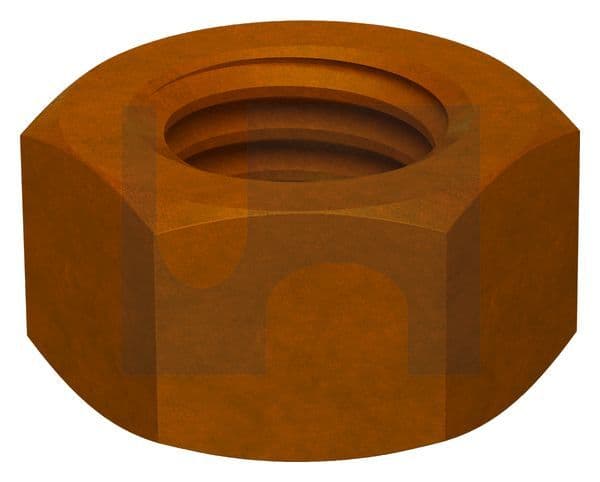
Class 10 · Class 8
Structural Nut
Heavy hex structural nuts for high strength structural bolting, led by the K0 class 8 nut to AS/NZS 1252:2016.
About the Structural Nut
Structural nuts are the heavy hex nuts of a high strength structural bolting assembly, for steel beams, columns and connections on buildings, facades and road and rail work. The main nut is the K0 property class 8 nut to AS/NZS 1252:2016, hot dip galvanised or plain from M12 to M36 (plain has no M22 or M33). There are also EN 14399 K2 class 10 galvanised nuts (M16 to M36), ASTM A563M class 8 weathering steel nuts (M24, M30, M36) and older AS 1252:1983 pattern class 8 nuts. Choose the standard, finish and size above; the guide below covers which nut goes with which bolt and tensioning.
Also called K0 nuts, AS/NZS 1252 nuts or HR structural nuts.
Features
- AS/NZS 1252:2016 K0
- For class 8.8 HR structural assemblies
- EN 14399 class 10 (K2) and ASTM A563M options
- Hot dip galvanised and plain
- Metric M12 to M36
Applications
- Structural steel connections
- Road and rail infrastructure, facades and high-rise
- Certified structural bolting
What is a structural nut?
A structural nut is the heavy hex nut of a high strength structural bolting assembly of bolt, nut and washer. In Hobson's range the K0 nut is the class 8 nut of its AS/NZS 1252:2016 K0 class 8.8 HR structural assembly; the class 10 K2 nut belongs to its EN 14399 K2 range, whose assemblies come in class 8.8 and 10.9; and the ASTM A563M class 8 nut belongs to its weathering steel range.
Hobson's overview of AS 1252:2016 says the biggest change from the 1983 and 1996 issues is a mandatory assembly test: the bolt, nut and washer are tested together, with the nut on the actual bolt, and the results give the truest indication of how that batch will perform. Hobson sells AS 1252 product as assemblies (on the hex bolt page). The nuts here are sold on their own, so for joints specified to AS/NZS 1252, order complete assemblies and use loose nuts only as the engineer or project specification allows.
Which structural nut: K0, K2 or weathering steel
- K0 structural nut, AS/NZS 1252:2016, property class 8: hot dip galvanised M12 to M36 (including M22, M27 and M33) and plain M12 to M36 (M12, M16, M20, M24, M27, M30, M36). Matches Hobson's K0 class 8.8 HR structural assemblies.
- K2 structural nut, EN 14399, class 10, hot dip galvanised: M16, M20, M24, M30 and M36. Part of Hobson's EN 14399 K2 range. It is thinner than the K0 nut of the same size (18.0mm against 21.3mm at M20), so do not swap one for the other.
- Weathering steel structural nut, ASTM A563M class 8: M24, M30 and M36. Hobson lists it for weathering steel structural applications, road and rail infrastructure, facades, stadiums and high-rise, and recommends it with its weathering steel Sampsonrod and ASTM F436M flat Sampson washers.
- AS 1252:1983 pattern structural nut, class 8: plain M16, M20, M24, M30 and M36, and hot dip galvanised M36. Hobson's structural guide lists them as the class 8 nuts of its AS 1252:1983 range, beside its AS 1252:1983 class 8.8 assemblies. Hobson's overview of AS 1252:2016 says the 2016 issue significantly raises the quality bar over the 1983 and 1996 issues, so check which issue the drawings call for. At M24 the 1983 pattern nut is taller than the K0 nut (25.3mm against 24.2mm).
Structural nut sizes and spanner sizes
Every structural nut we carry. Select a row to open that nut in the selector.
Dimensions in mm: across flats (the spanner or socket size), nut height and across corners. K0, K2 and AS 1252:1983 pattern nuts from Hobson's dimension data (the selector's dimensions panel); weathering steel nuts from Hobson's Did You Know sheet (250515DYK). Pack is the minimum order quantity. Tap a number to show it in the selector above.
AS/NZS 1252, EN 14399 and the drawings
The engineer's drawings and project specification set the bolting category, the assembly and how it is tensioned. Hobson's article on the 2020 changes to AS 4100 and AS/NZS 5131 summarises how its ranges fit:
- AS 4100:2020 now refers fabrication and erection, including bolt tensioning and inspection, to AS/NZS 5131.
- AS/NZS 1252 names EN 14399-3 8.8 HR assemblies as an alternative where AS/NZS 1252 is specified. Only System HR assemblies are alternatives; System HV assemblies (EN 14399-4) are not.
- AS/NZS 1252 has no class 10.9 product, so EN 14399-3 10.9 HR is the additional assembly type where 10.9 assemblies are specified.
- For Queensland TMR work, Hobson's MRTS278 article says EN 14399 K2 8.8/10.9 HR assemblies are exempt from the AS/NZS 1252.2 verification testing and the MRTS278 assembly test, provided the order is fully traceable and supplied with a CE certificate, a factory production control inspection certificate, a declaration of performance and a Type 3.1 inspection certificate to EN 10204 verifying compliance to the relevant specification and any surface coating applied. This is from the November 2020 issue of MRTS278, per Hobson's 2021 article; check the current issue.
- Traceability: Hobson puts a unique 3-character trace code on its structural bolt heads and a trace number on the carton label; either finds the certificates on Hobson's website.
Tightening structural bolts: tension, not torque
Hobson's Squirter DTI troubleshooting article puts it plainly: torque is not tension, and torque values are not published for structural assemblies because torque cannot be used for installation (refer to AS 4100). Hobson's structural guide shows three tensioning methods: part-turn (rotation of the nut relative to the bolt), DTI washers (the bumps compress and squirt) and TC bolts (the spline end shears off).
Friction is the usual problem. The same article recommends stick wax on the bolt threads and the washer face of the nut, so the assembly reaches tension with less torque, and notes white rust on galvanised bolts adds friction, so store bolting dry.
Not for TC bolts: Hobson says additional lubrication should never be applied to TCBOLTs, as it gives a higher tension than calibrated. Use TC bolts as supplied, with no stick wax.
Thin nuts on structural bolts
Hobson's lock-nut advice for AS 1252 assemblies: AS 1252 does not cover lock-nuts, which are only needed where bolts are tightened snug tight (bolting category 8.8/S) and the joint is subject to vibration. The right one is a hot dip galvanised AS 1112.4 thin nut of property class 04. Fit it above the structural washer and finger tighten it, fit the class 8 full nut, then tighten the full nut while holding the lock-nut with a thin spanner until both nuts bear on opposite thread flanks.
The thin nut is working as a locking washer and the strength comes from the class 8 nut, so a class 8 lock-nut is not needed. Lock-nuts are generally not needed in fully tensioned joints (8.8/TF and 8.8/TB); if one is used there, only the part-turn method applies, the lock-nut's thickness is added to the grip length, and no DTIs or torque methods should be used with it.
Galvanised, plain or weathering steel?
- Hot dip galvanised: Hobson rates it high corrosion resistance and recommends it for long term outdoor use. Its corrosion guide gives hot dip galvanising or stainless as the minimum for steel exposed to the weather, and stainless only in the sea spray zone; that guide is written for building connectors, so for structural bolting the engineer sets the coating. Hobson's article on galvanising notes the newer matt grey finish performs the same as the old bright finish: coating mass, not shine, sets the life.
- Plain: no coating, supplied lightly oiled to inhibit rust in the packaging. Plain steel is not a minimum for any exposure in Hobson's corrosion guide, so use it only where the project specification calls for plain bolting.
- Weathering steel: a patina forms and matures on the surface with alternating wet and dry conditions, and Hobson lists the nut as suitable for use with Redcor compositions A and B. Hobson's AS 4100 article says hot dip galvanised fasteners are not recommended with weathering steel, because contact between the uncoated steel and the zinc causes galvanic corrosion: use weathering steel bolting there.
Structural nuts in Adelaide
Allmat supplies structural nuts, bolt assemblies, structural and DTI washers and TC bolts to steel fabricators and erectors across Adelaide and South Australia. Send us your bolting list and we will price the lot.
Structural nuts and bolting gear
Structural nuts, bolt assemblies, structural and DTI washers and stick wax for them, and TC bolts (used as supplied, never waxed) are available to order from Allmat for steel fabricators, erectors, builders and trade across Adelaide and South Australia. Order through Allmat, we pick and pack it, then click and collect from the Allmat yard or have it delivered to site.
Goes with
Questions
What is a K0 structural nut?
The property class 8 nut of Hobson's AS/NZS 1252:2016 K0 class 8.8 HR structural assembly, hot dip galvanised or plain, M12 to M36.
What is the difference between K0 and K2 structural nuts?
The K0 nut is a class 8 nut to AS/NZS 1252:2016; the K2 nut is a class 10 nut to EN 14399 for Hobson's K2 range. They are different heights (at M20, 21.3mm for K0 and 18.0mm for K2), so use the nut that belongs to the assembly on the drawings.
What spanner fits an M20 structural nut?
32mm across flats, on both the K0 and K2 nuts. M16 is 27mm, M24 41mm, M30 50mm and M36 60mm.
What torque do I use on a structural nut?
None from Hobson: it says torque values are not published for structural assemblies because torque cannot be used for installation. Tension them by the part-turn method, DTI washers or TC bolts, as the specification requires.
Can I use galvanised nuts on weathering steel?
Hobson's AS 4100 article says hot dip galvanised fasteners are not recommended with weathering steel, because the contact between uncoated steel and zinc causes galvanic corrosion. Use the ASTM A563M weathering steel nuts and bolting.
Can I fit a lock-nut (thin nut) on a structural bolt?
Only where the specification allows it. Hobson's advice for AS 1252 assemblies in snug tight joints subject to vibration is a hot dip galvanised AS 1112.4 class 04 thin nut fitted under the class 8 full nut. In fully tensioned joints lock-nuts are generally not needed.
Where can I buy structural nuts in Adelaide?
Order through Allmat. Order ahead by phone on 1300 03 03 63 or send your list for a quote, then click and collect from 25 Kapara Road, Gillman, or have them delivered to site.
Structural Nut: sizes and finishes we supply
30 lines by type and finish. Pick one above for its product code, pack sizes and dimensions.
| Style | Finish | Sizes | Lines |
|---|---|---|---|
| Standard | Galvanised | M12, M16, M20, M22, M24, M27, M30, M33, M36 | 14 |
| Standard | Steel | M12, M16, M20, M24, M27, M30, M36 | 7 |
| AS 1252:1983 pattern | Steel | M16, M20, M24, M30, M36 | 5 |
| Standard | Weathering Steel | M24, M30, M36 | 3 |
| AS 1252:1983 pattern | Galvanised | M36 | 1 |
Data sheets and documents
The documents for the product you choose are listed with the selector above. Here is every Structural Nut document from Hobson Engineering.
All Structural Nut documents (7)
Data sheets and technical data (2)
Did You Know flyers (2)
Need them in bulk?
Add the sizes you need to your quote, or send us your list and we’ll price the lot and supply it with the rest of your order.
Browse all nuts